
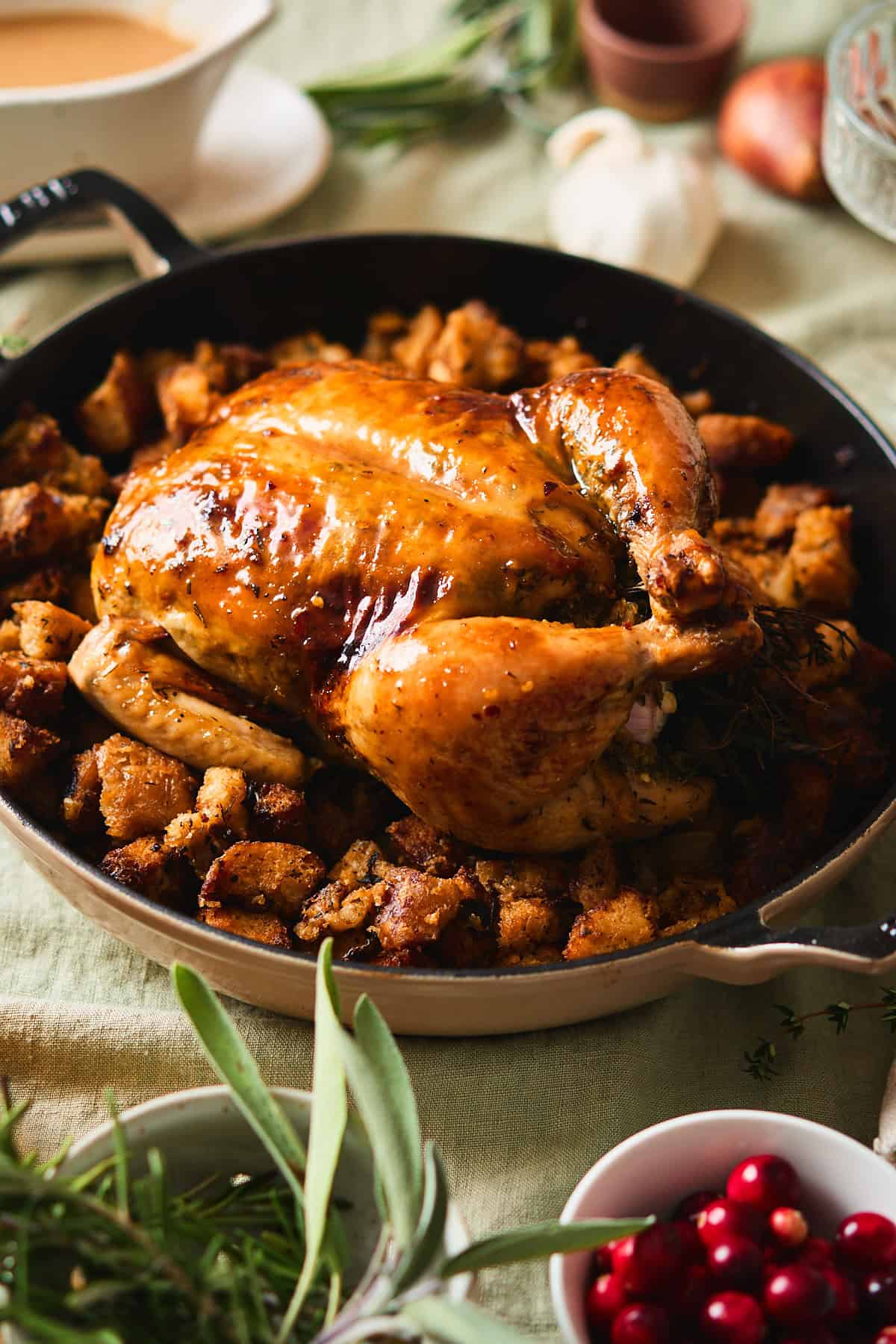
This Thanksgiving Chicken is for everyone who wants the whole holiday spread without wrestling a giant turkey. A whole roast chicken gets a generous slather of herby Dijon butter tucked under the skin, then roasts right on top of a bed of cubed sourdough, onion, and celery. All of the drippings soak into the bread, so the stuffing basically makes itself. A maple Dijon glaze goes on at the end and turns glossy and golden for the perfect holiday-table look, and a rich, from-scratch gravy simmers away while the chicken roasts. It's the Thanksgiving dinner you're craving, scaled down for a smaller table. 🤤
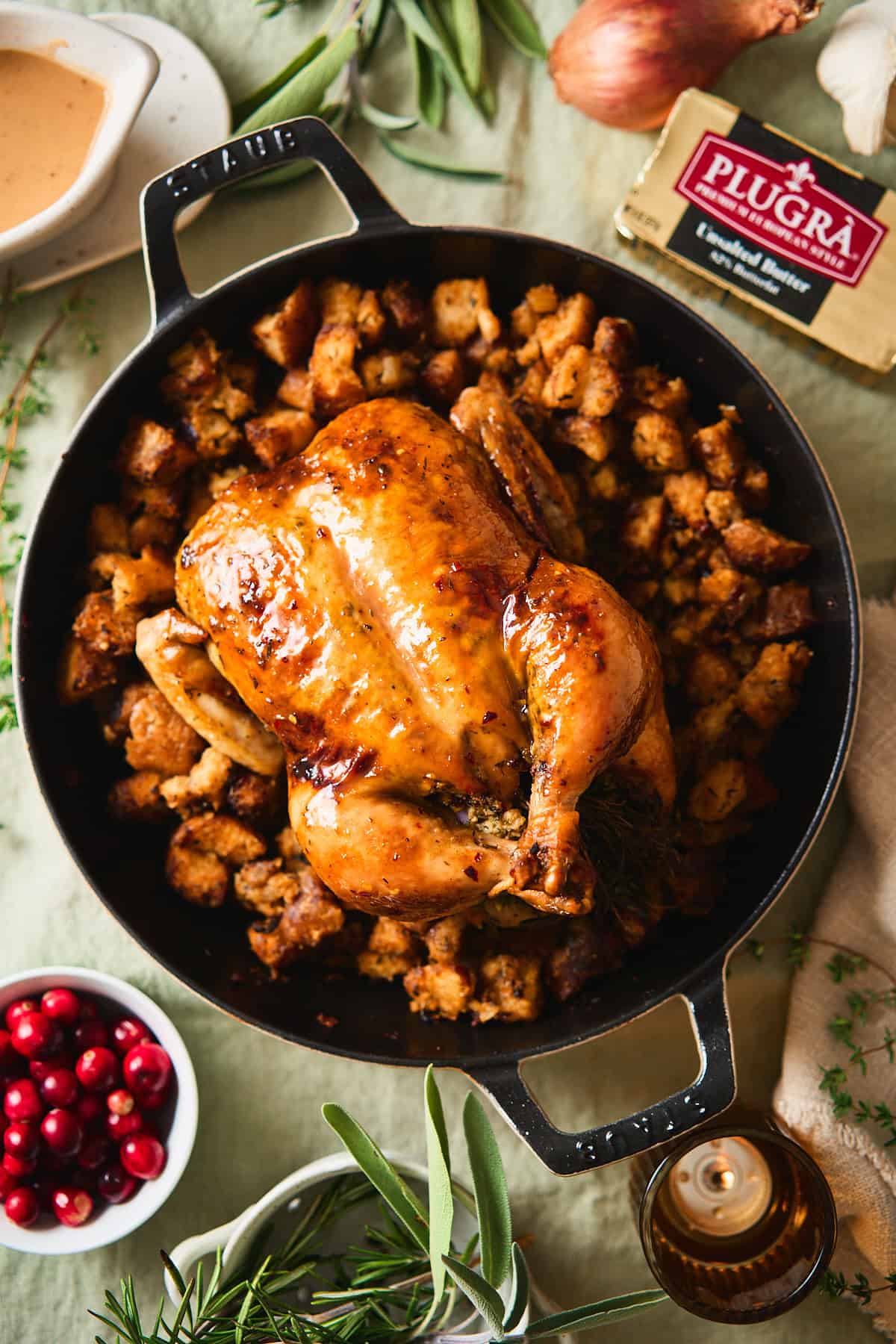
Disclosure: This post is a paid partnership with Plugrà Premium European Style Butter, the official butter partner for A Full Living for 2026! Butter is in every part of this dinner, from under the skin to the stuffing to the last whisk of the gravy, so better butter really matters here. As always, all opinions are our own.
A Small Thanksgiving Dinner Still Deserves a Showstopper 🍗
We have a confession: we don't usually cook a whole turkey for Thanksgiving. We have nothing against turkey! But a lot of years it's just the two of us, or us plus my brother Logan and his girlfriend Trudy, and a whole bird is a big production for a small table.
Our go-tos are often smothered turkey wings or small-batch seafood boil foil packs, but this year we wanted something that felt a little more like Thanksgiving, so we went with a roast chicken. It's every bit as stunning as a turkey, takes a fraction of the time, and needs no days of thawing. Plus, the chicken and stuffing cook together in one 12-inch pan.
This one took us a few rounds to get right! We started with a spatchcocked bird, but laid flat, it covered the entire pan and hid all of that stuffing. 😂 Roasting it whole fixed the problem, and it looks a lot more like Thanksgiving, too. Now the chicken sits right on top of the stuffing, so there's no extra casserole dish fighting for oven space.
Making Thanksgiving dinner for two? Make it as written and plan on leftovers, because the extra chicken would be right at home in our creamy chicken pot pie soup. And it's not just for Thanksgiving. It makes a cozy Sunday dinner any time of year!
🍽️ Cooking for a bigger group? Our apple stuffed pork loin is a great holiday main for a fuller table.
🍗 Ingredients for Thanksgiving Roast Chicken
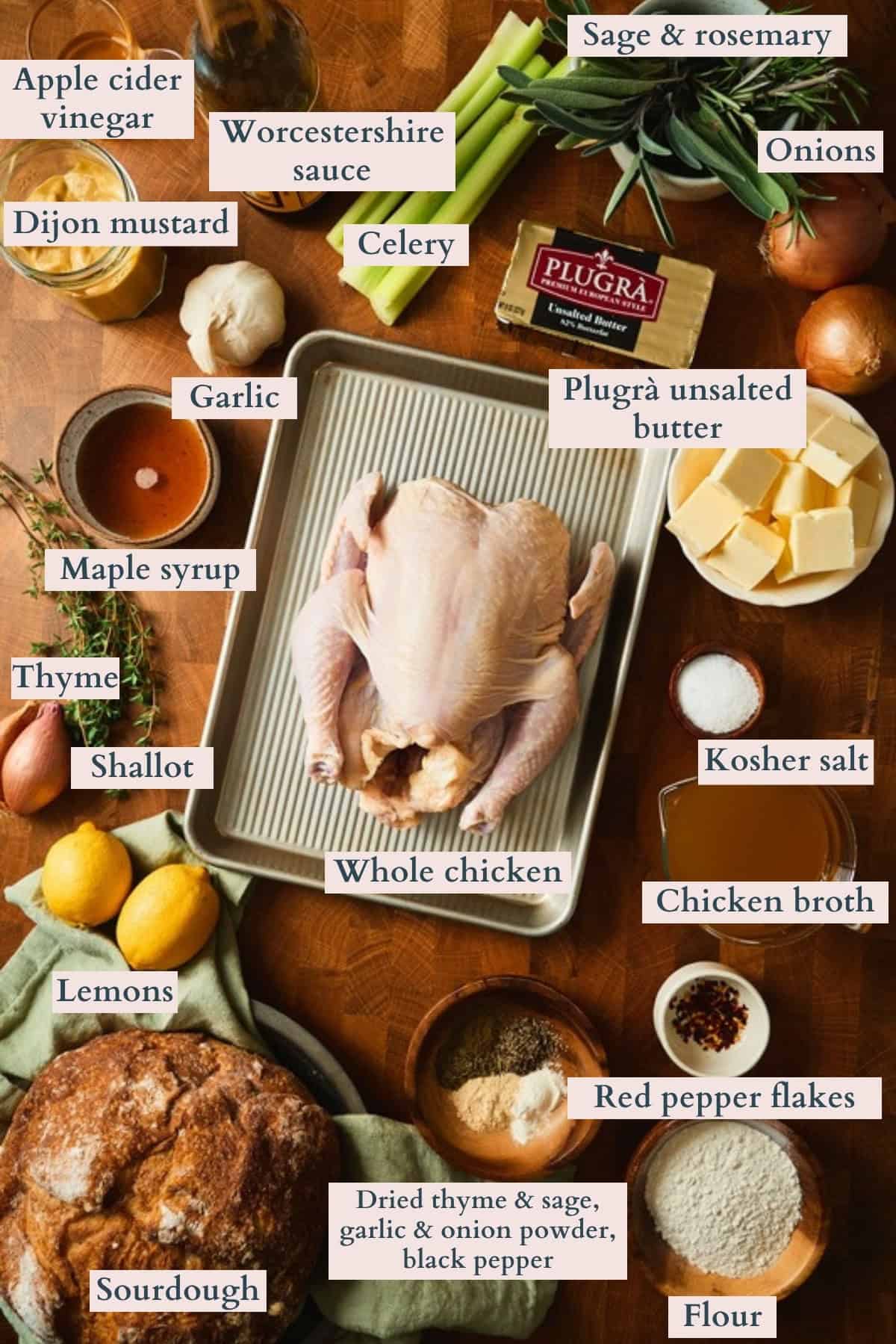
Most of this is a regular grocery run: one whole chicken, a sturdy loaf of sourdough, the usual stuffing vegetables, a handful of fresh herbs, and good butter. Grab more butter than you think you need, because it shows up in every part of this dinner! 😉
How to Make Roast Chicken with Stuffing in One Pan ✨
Most of the hands-on work happens the night before and in the first hour. After that, it's mostly hands-off, with your thermometer telling you when it's done.
Dry Brine the Chicken
The night before, pull out the neck if your bird came with one, and trim the extra fat and skin from around the cavity opening. Pop them in the fridge, because they're going into the gravy!
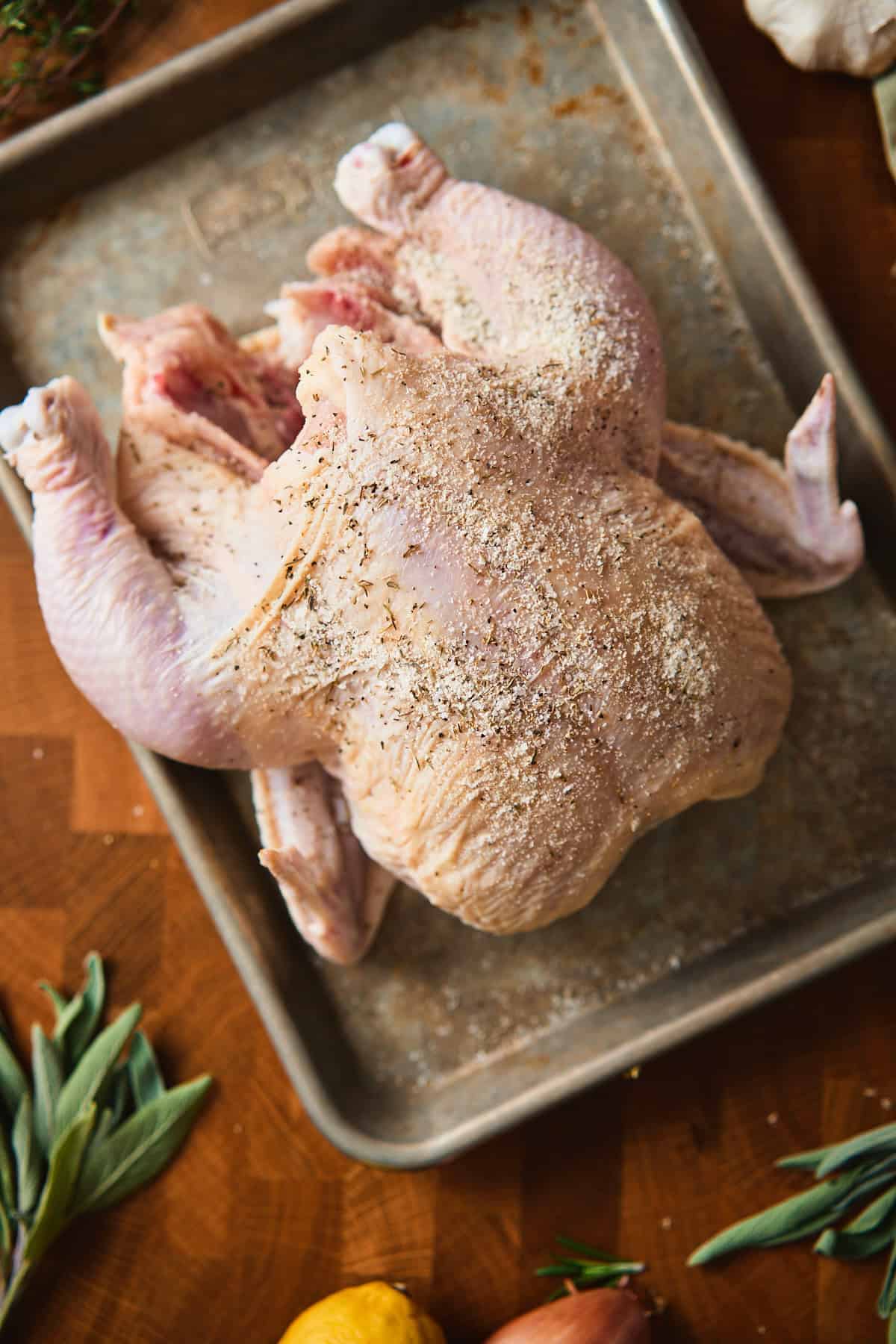
- Step 1: Pat the chicken dry. Mix the kosher salt, dried thyme, dried sage, garlic powder, onion powder, and black pepper, and sprinkle it all over the bird.
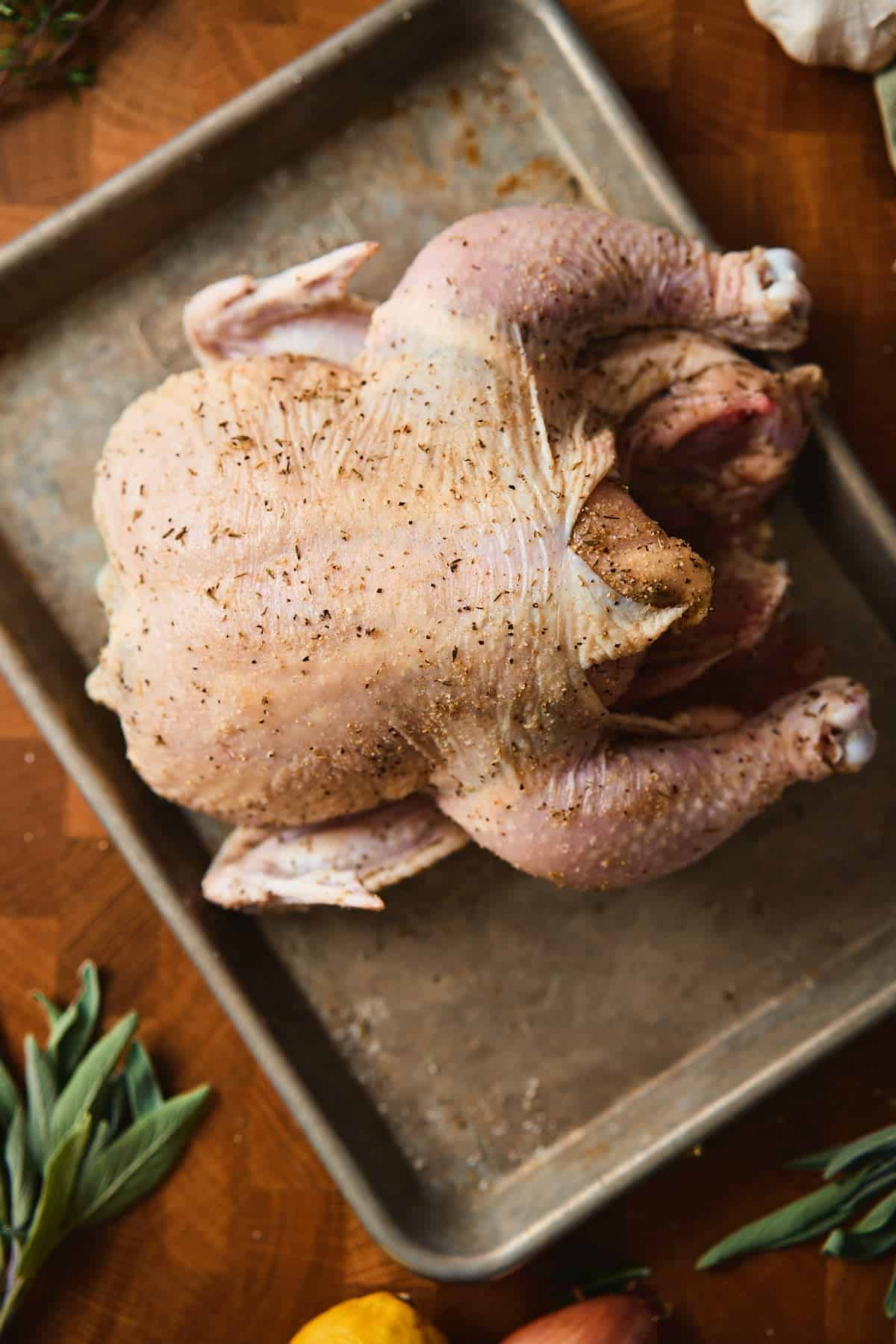
Rub the seasoning all over the bird and inside the cavity, then refrigerate it uncovered overnight.
🧂 Season by weight if you can. We use Diamond Crystal kosher salt at 1% of the bird's weight, which keeps the meat juicy and seasoned all the way through. For the 4-pound bird in these photos, that's 18 grams: about 2 tablespoons of Diamond Crystal, 1¼ tablespoons of Morton's kosher salt, or 1 tablespoon of table salt. Leaving it uncovered dries out the skin, which is what you want for browning.
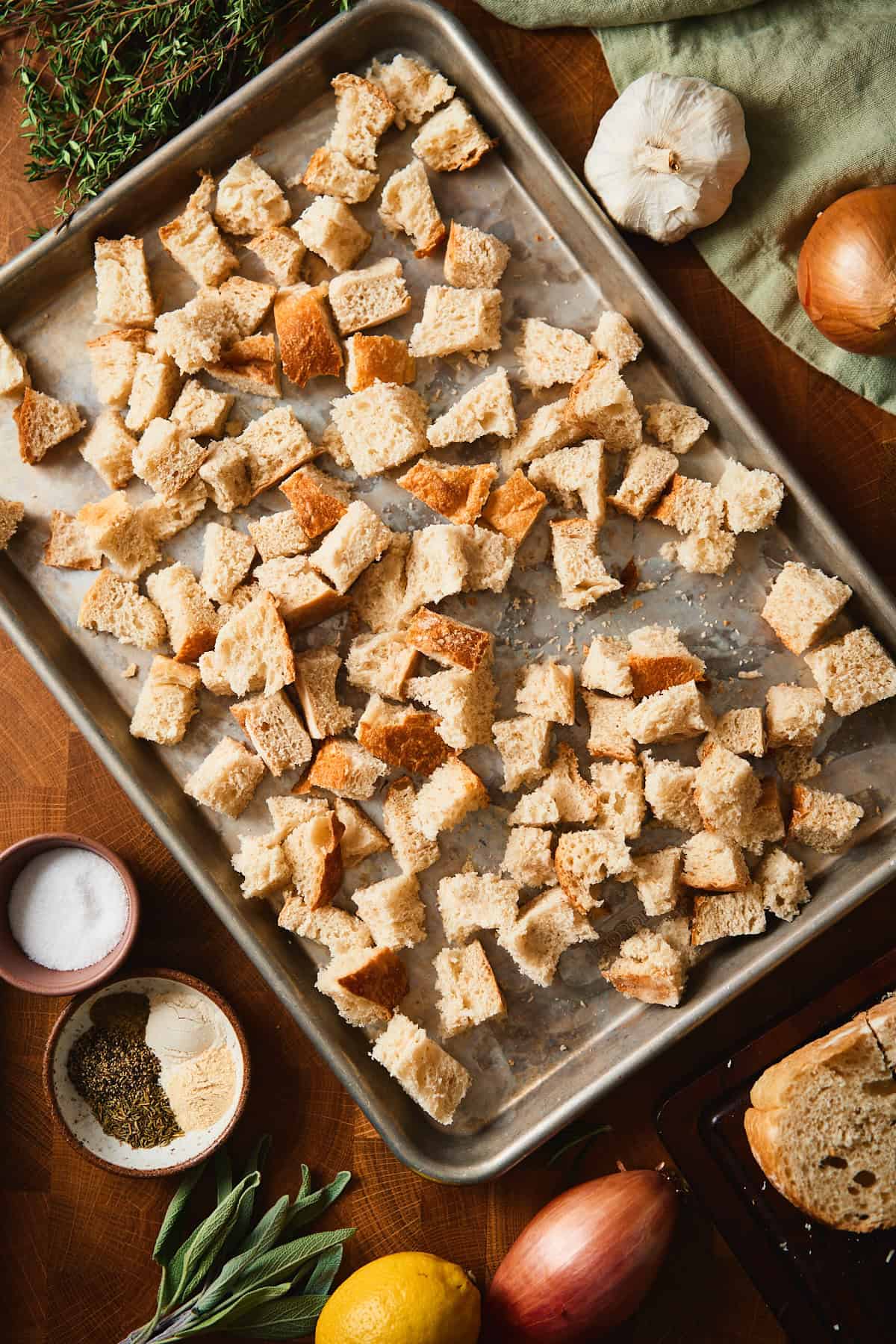
- Step 2: While you're at it, cut the sourdough into 1-inch cubes and spread them out on a sheet pan. Leave them on the counter overnight to dry out. Dried bread can soak up all of that butter without turning to mush.
🍞 Forgot to cut the bread? We've done it more than once! 😂 Dry the cubes in a 275°F oven for 20 to 30 minutes, tossing halfway, until they're crisp but not browned.
Make the Herb Butter
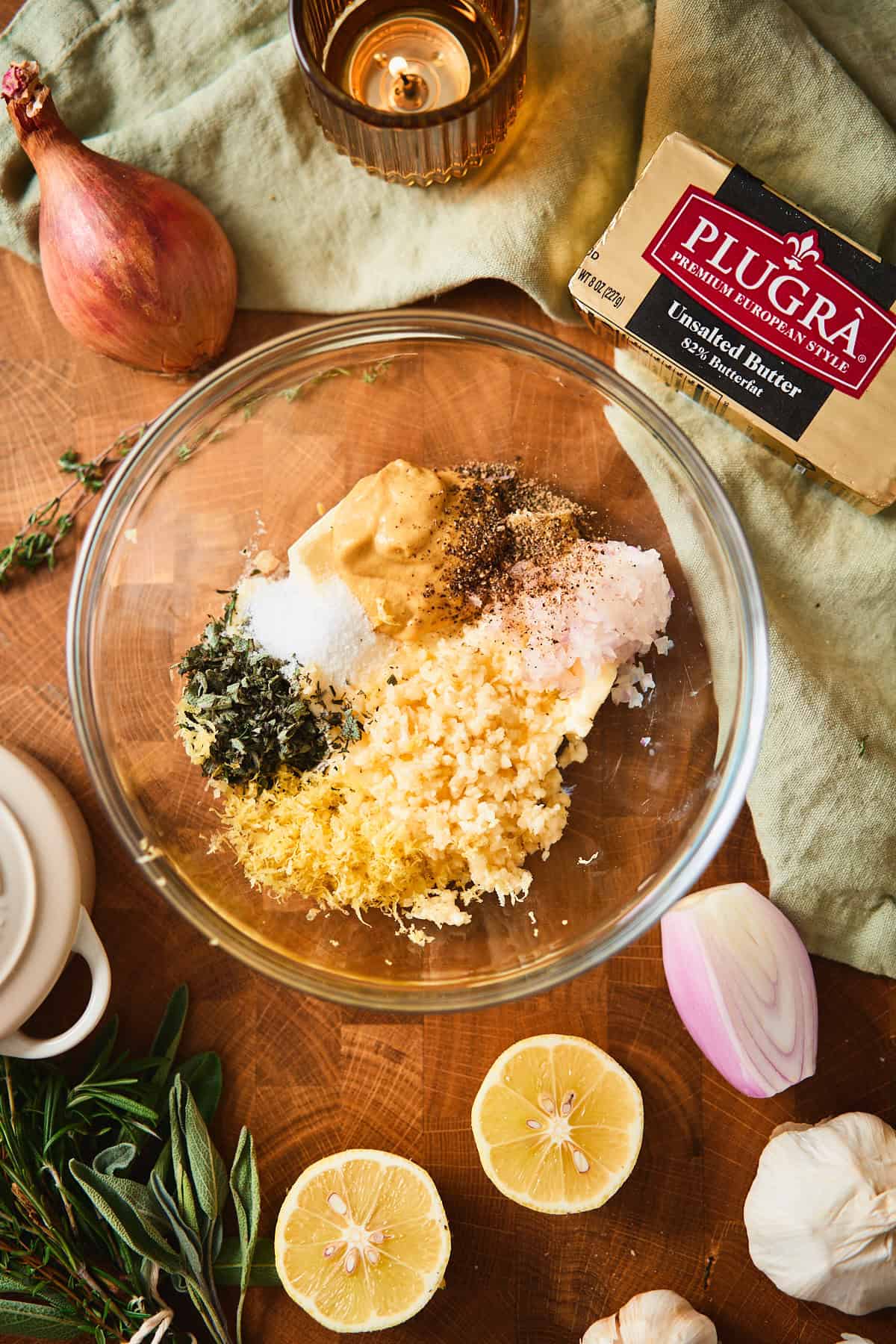
- Step 3: The next day, heat the oven to 425°F with the rack in the lower-middle position. Add the softened Plugrà to a bowl with the Dijon, minced garlic, finely minced shallot, finely chopped thyme, sage, and rosemary, lemon zest, salt, and cracked black pepper. Save the zested lemon for later.
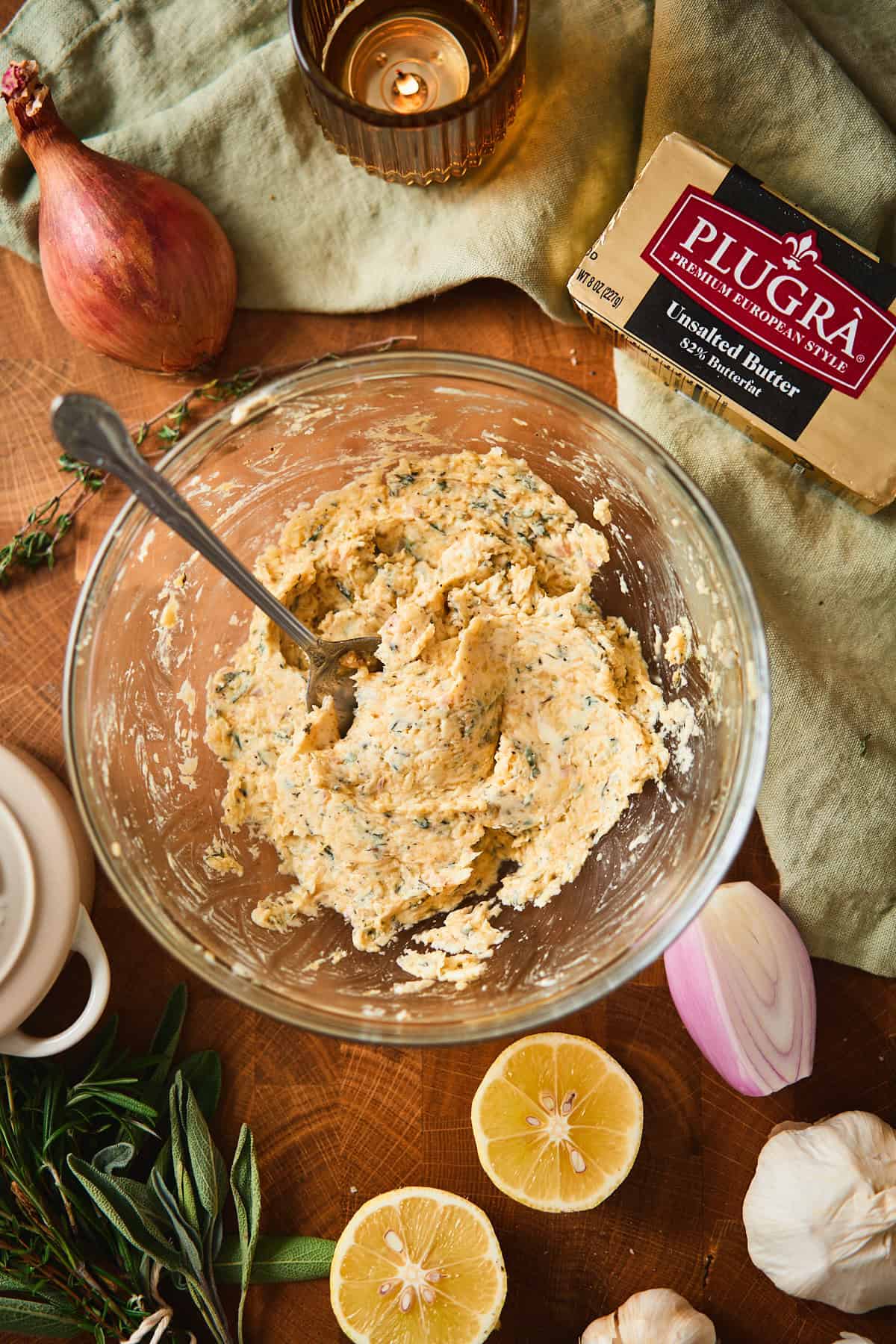
Mash it all together until the herbs and garlic are evenly mixed in. Short on time? A mini food processor works too. Blend everything except the herbs and zest, then stir those in by hand so the blade doesn't bruise them and turn the butter brown.
🧈 Why this butter matters. Plugrà has 82% butterfat, so it's richer and has less water than standard American butter. Less water helps the skin brown better, and you'll taste that richer flavor here since so much of it goes right under the skin.
🧂 Stick with unsalted if you can. Unsalted butter gives you full control over the salt level, which matters here since the bird is already seasoned from the brine. When we tested with salted butter and kept the other salt the same, the breast skin came out a little too salty. Salted butter still works, just cut back on the added salt: use half the salt in both the seasoned butter and the stuffing, and taste the gravy before salting it.
Build the Stuffing
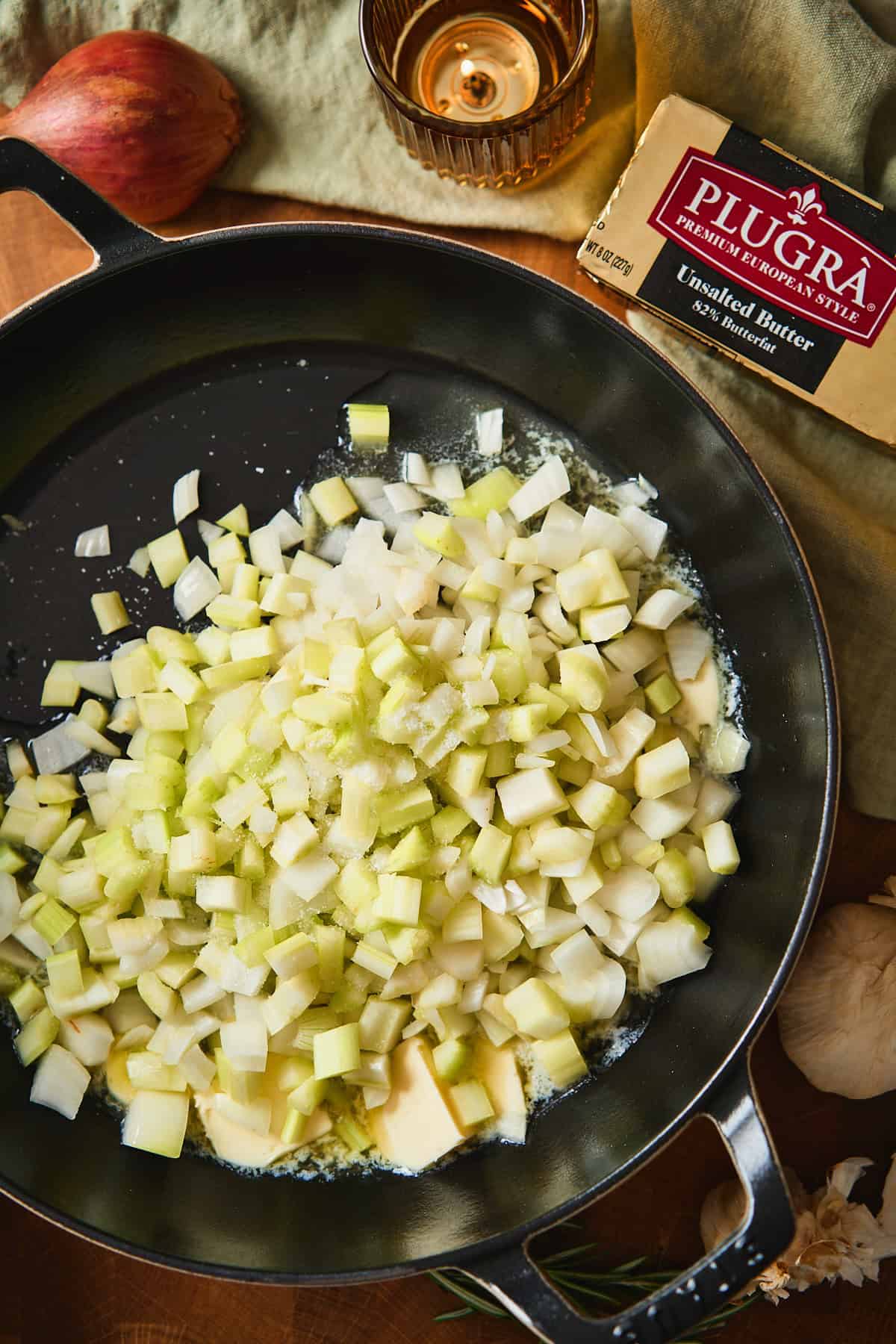
- Step 4: Melt more butter in a deep 12-inch oven-safe skillet and add the onion, celery, and kosher salt.
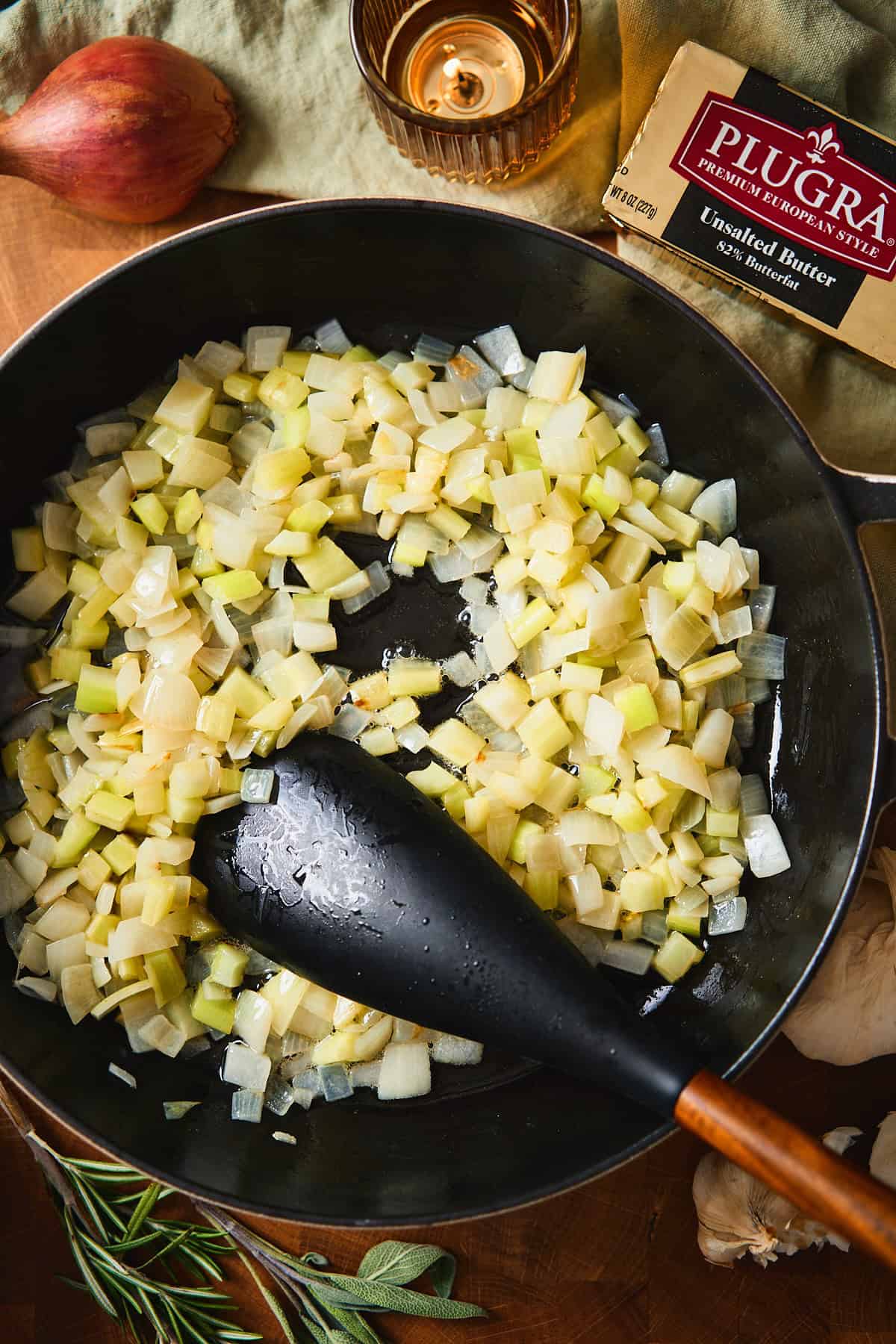
Cook, stirring now and then, until they're soft.
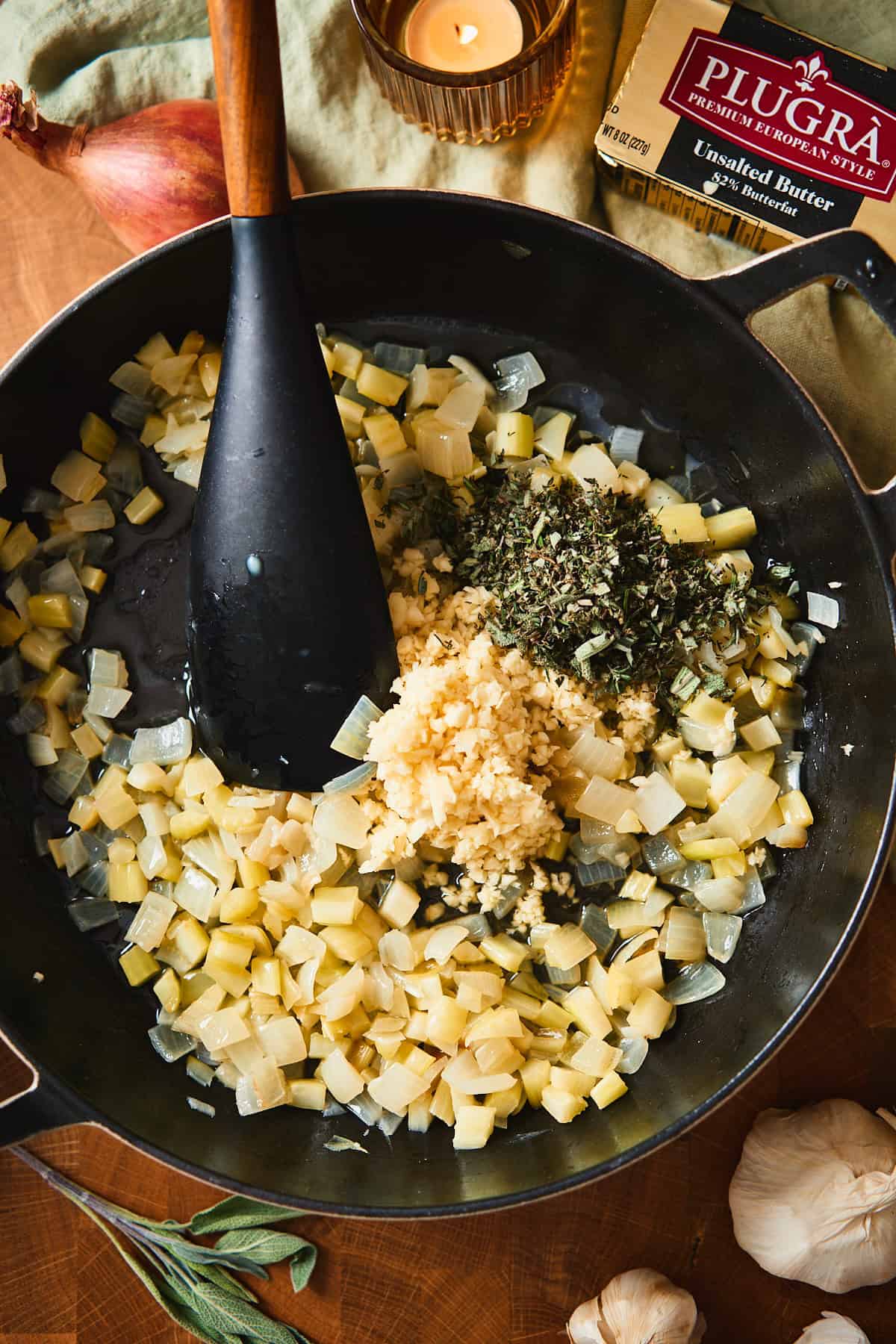
- Step 5: Add the garlic, thyme, rosemary, and sage and cook for 1 minute.
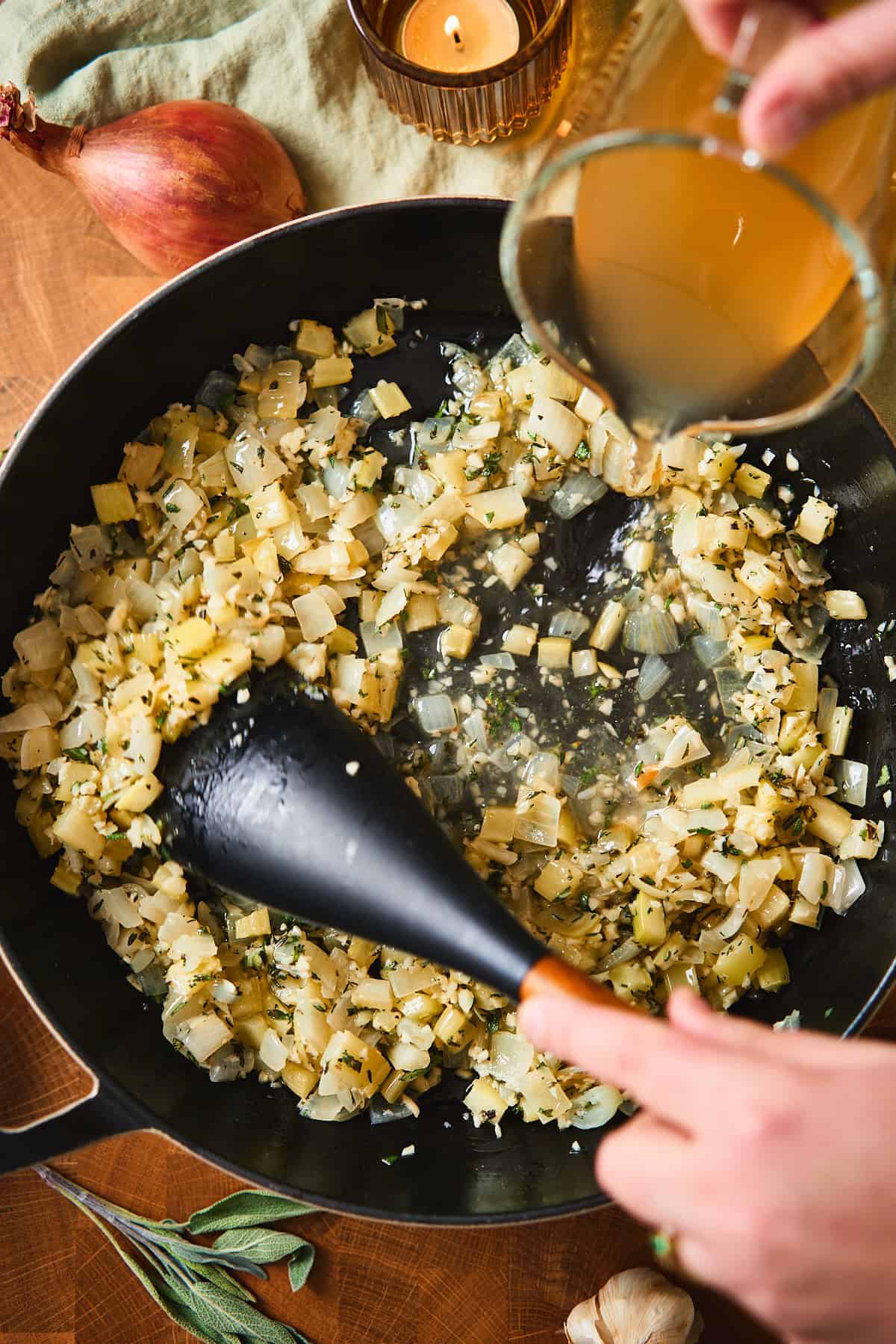
Turn off the heat and pour in the chicken broth to stop the cooking.
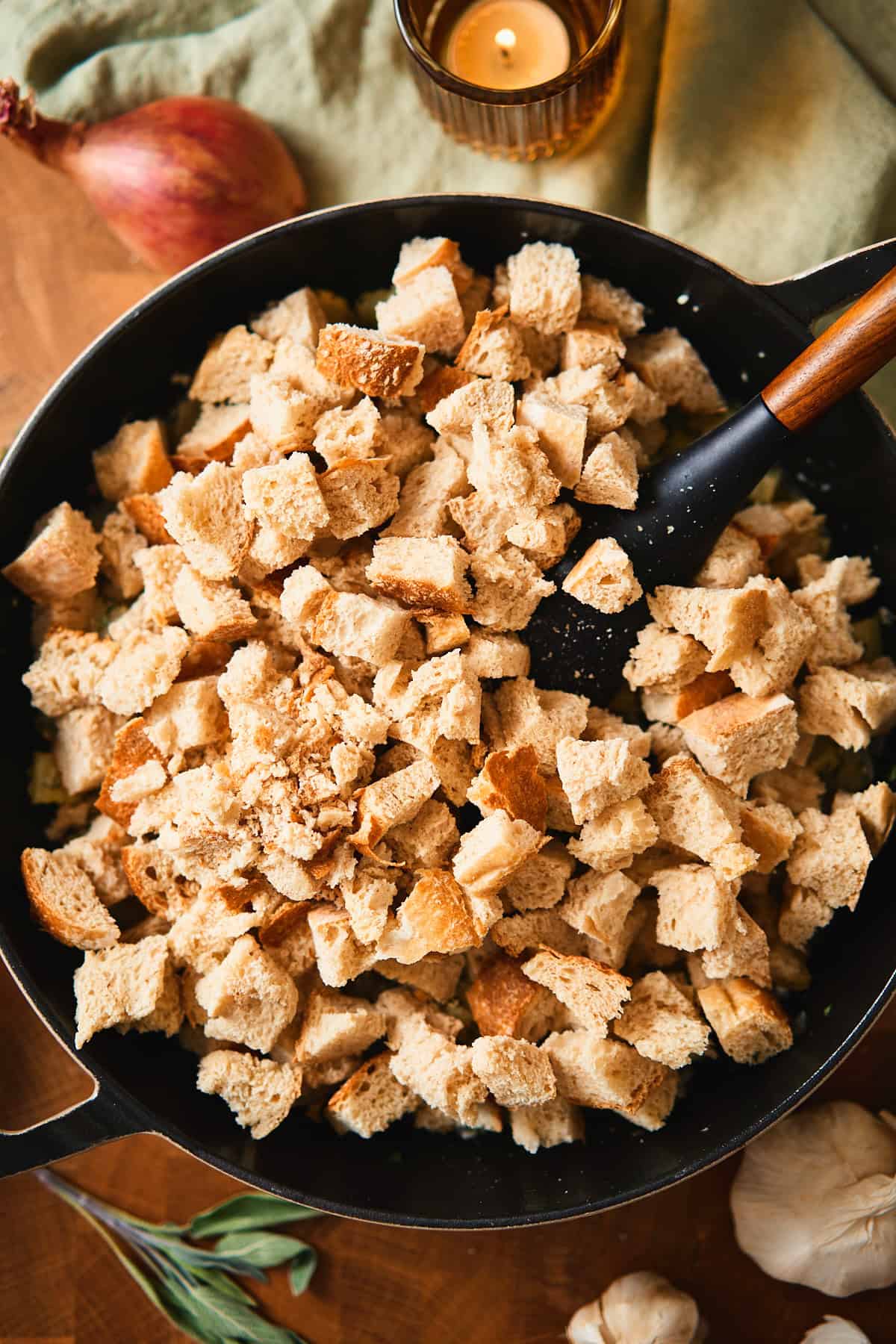
- Step 6: Add the cubed bread and season with black pepper, plus more salt to taste. Go a little light on the extra salt at first, since the drippings will season the stuffing more in the oven.
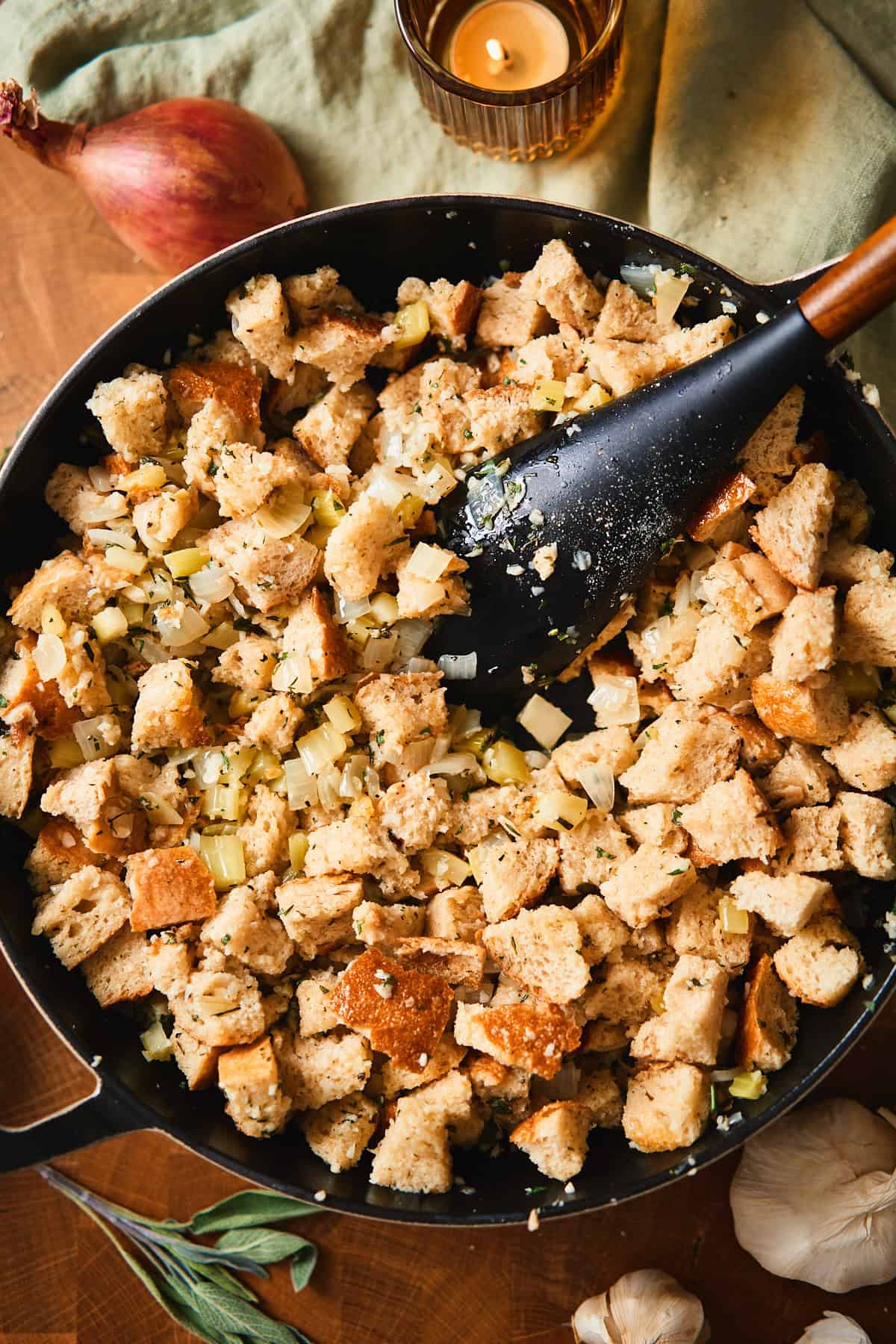
Toss until the bread is evenly coated, then spread it into an even layer for the bird to sit on, piling any extra around the edges.
🍳 Pan and broth notes. We use a 12-inch Staub braiser with no lid, but any deep 12-inch oven-safe skillet works, as long as the bird fits with a ring of stuffing showing around it. No deep skillet? Cook the vegetables in whatever skillet you have, then move everything to a baking dish before adding the bird. Start slow with the broth, because the bread picks up extra moisture from the chicken drippings in the oven. The batch we made with more broth came out too wet.
Butter and Truss the Chicken
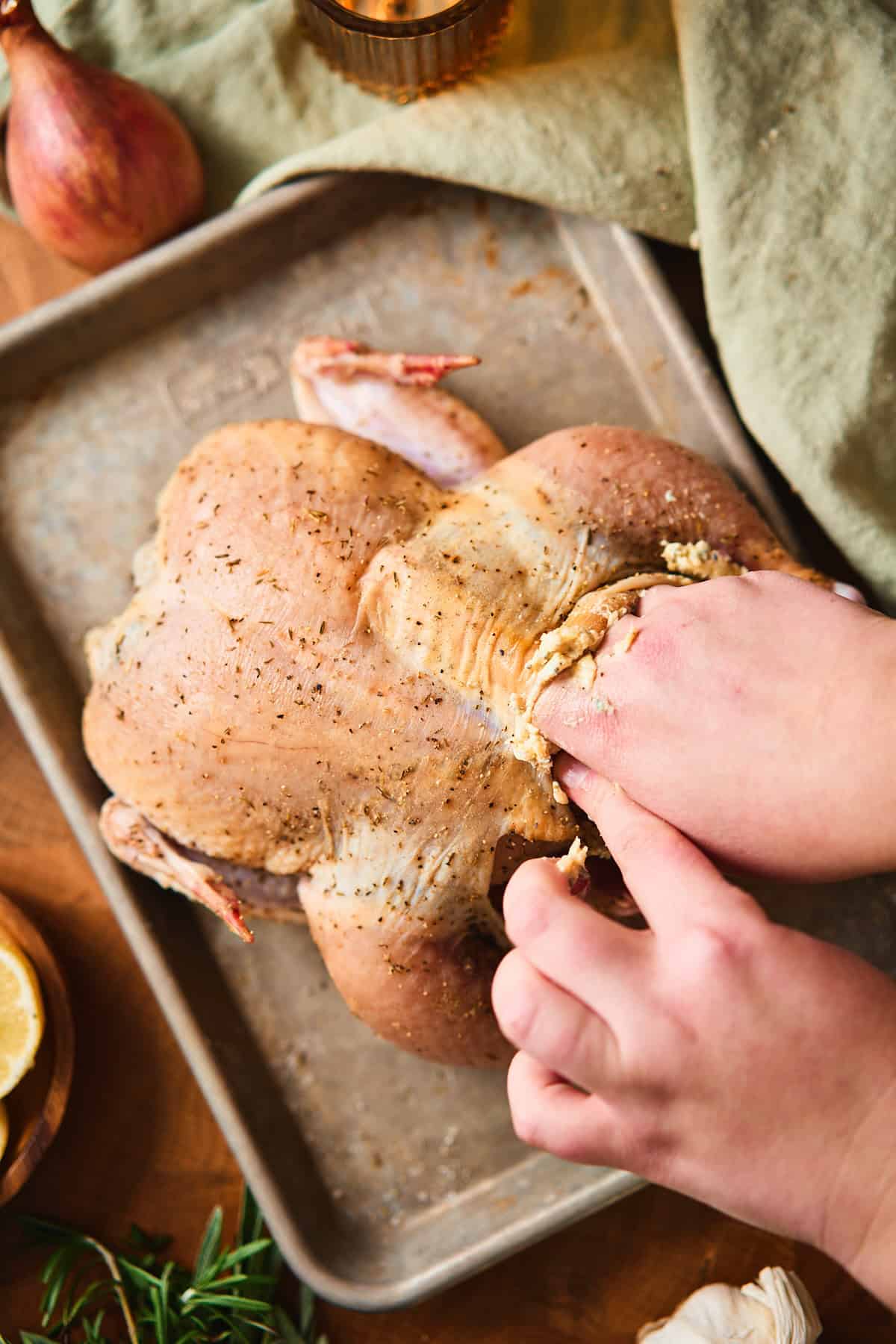
- Step 7: Pat the bird dry and tuck the wings. Gently loosen the skin over the breast and thighs, work all of the seasoned butter underneath, and press it flat from the outside.
⚠️ Work slowly, and keep the butter under the skin. The skin tears easily, and we ripped ours in our first test, which left gaps. Keeping the butter underneath also protects the garlic, shallot, and herbs from the oven's high heat. When we rubbed the butter on top of the skin as well, it baked into a crust that didn't look great and burned a little. The dry brine does most of the work for the skin, so all it needs on top is a quick brush of melted butter to help it brown.
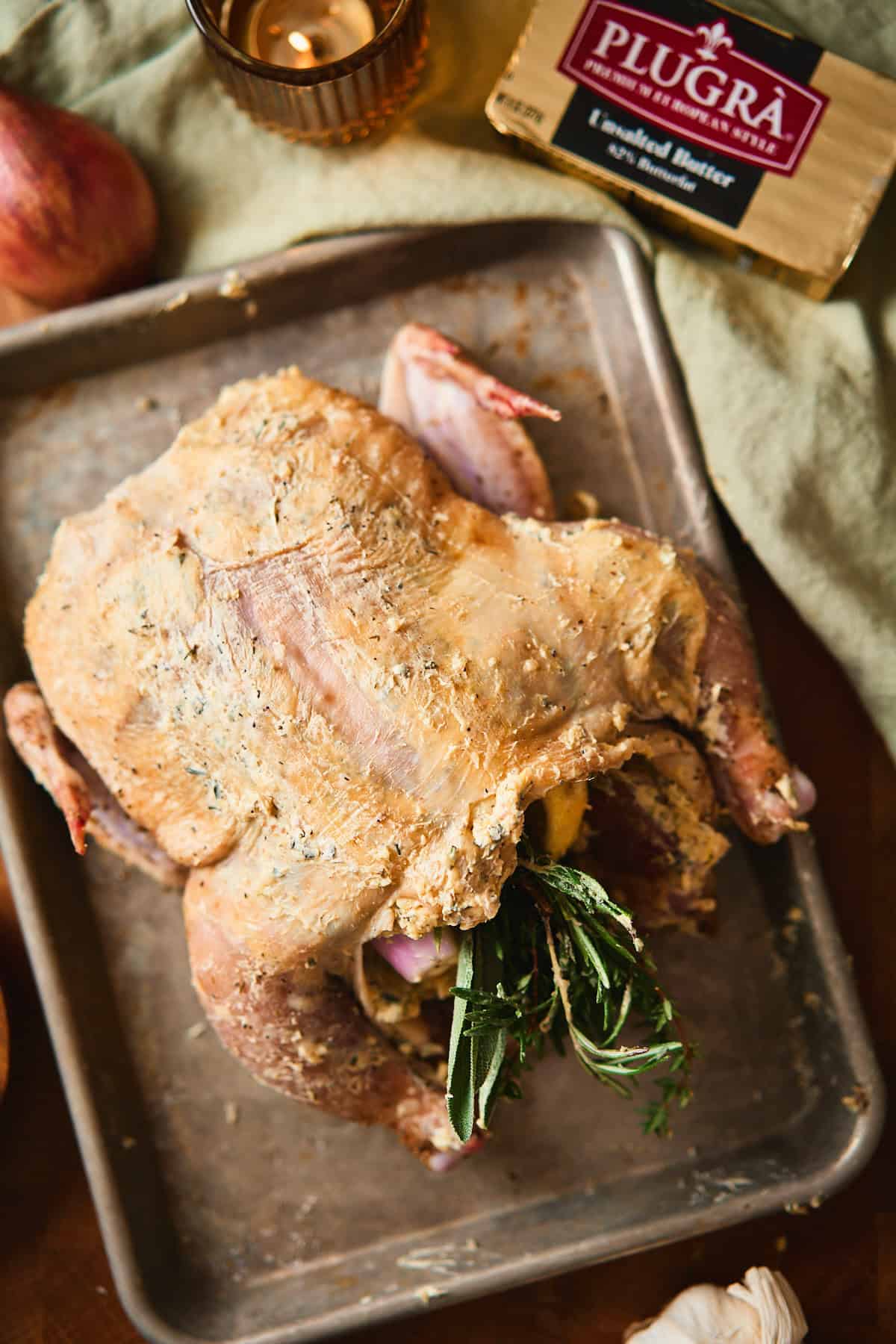
- Step 8: Halve the zested lemon and tuck one half into the cavity with a halved shallot and a small bundle of fresh herbs. Save the other lemon half for the gravy.
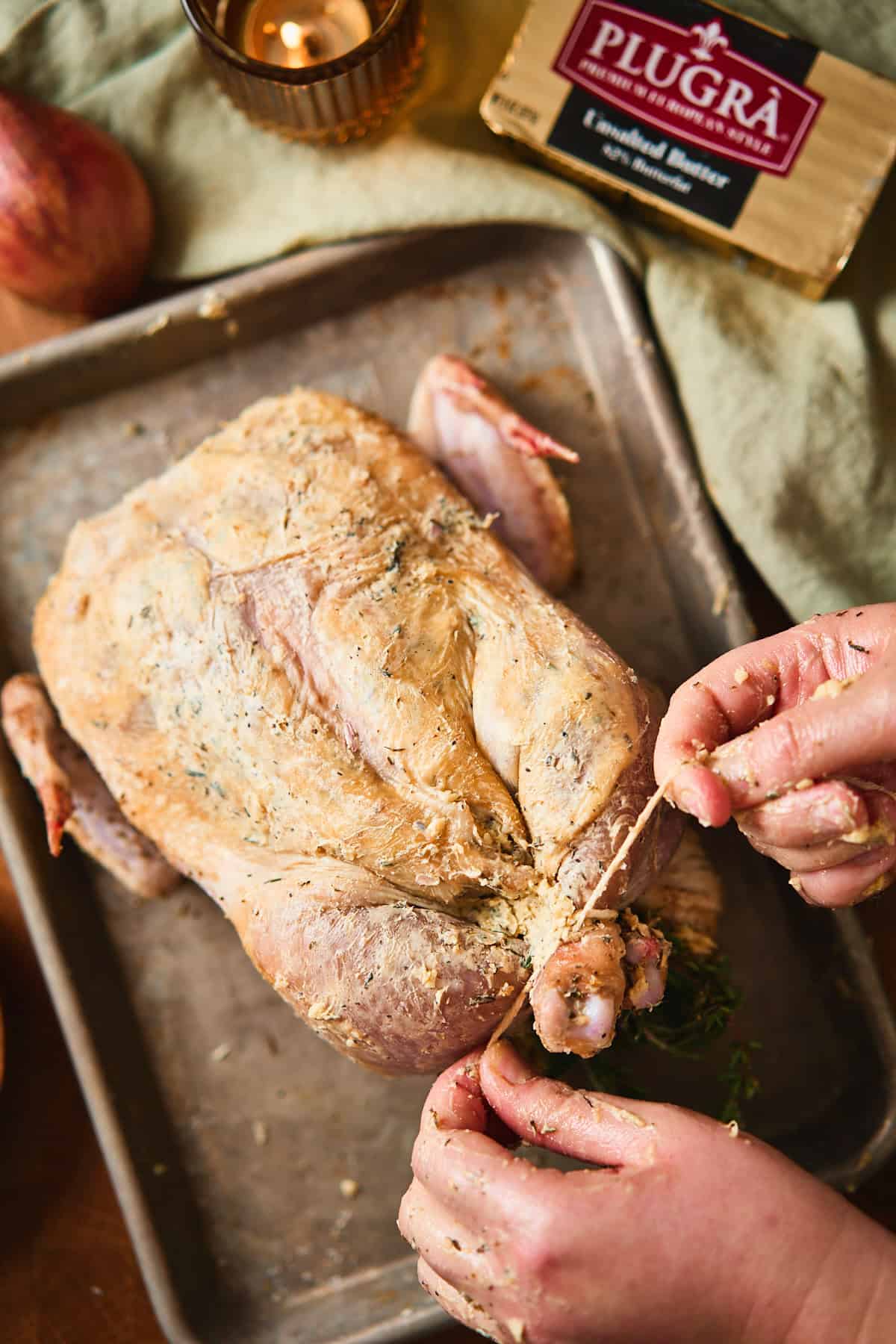
Truss the legs together with kitchen twine. You can truss the wings to the body too, but we find it easier to just tuck them underneath.
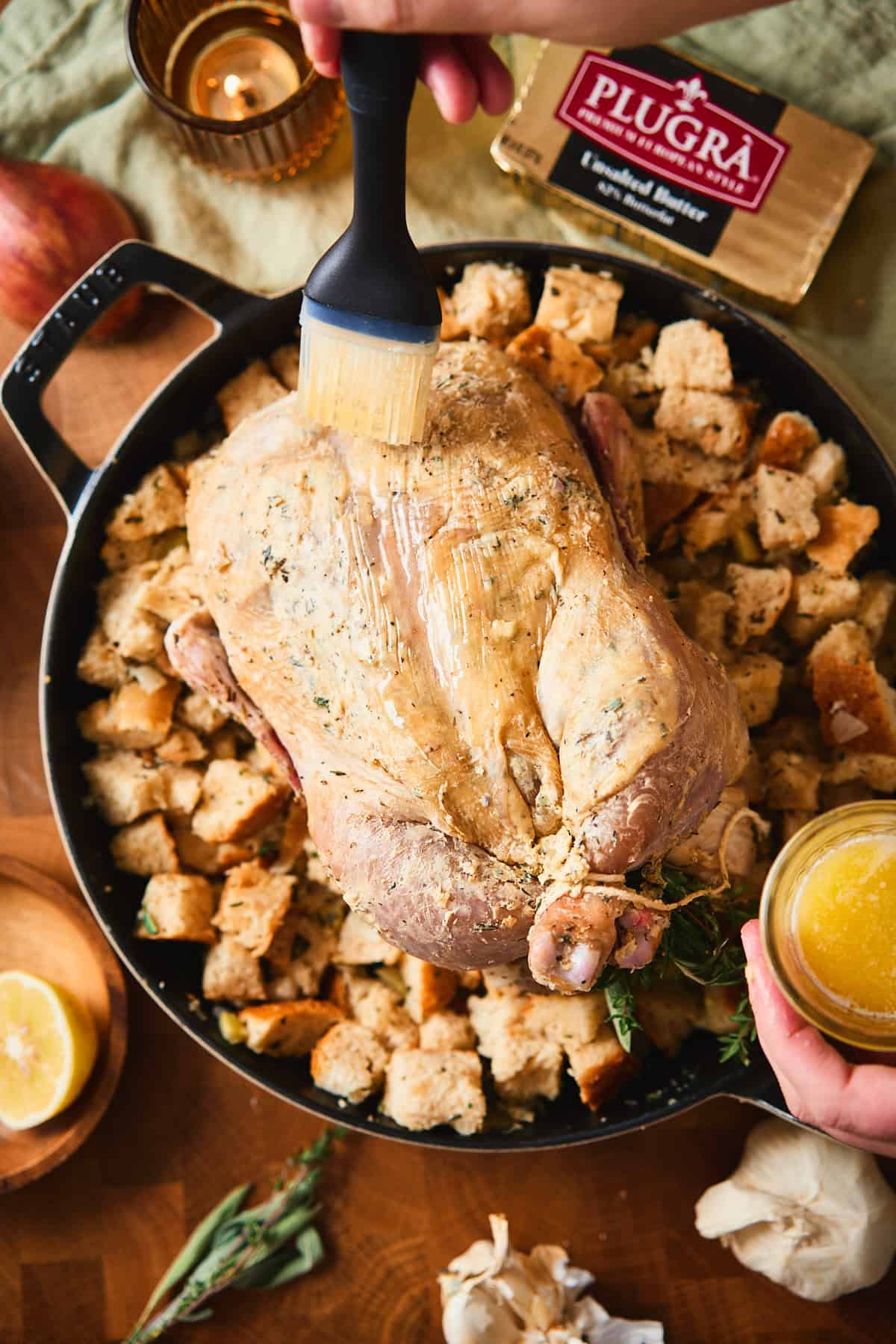
- Step 9: Brush melted butter over the skin, and set the chicken breast side up in the center of the stuffing.
Roast and Glaze the Chicken
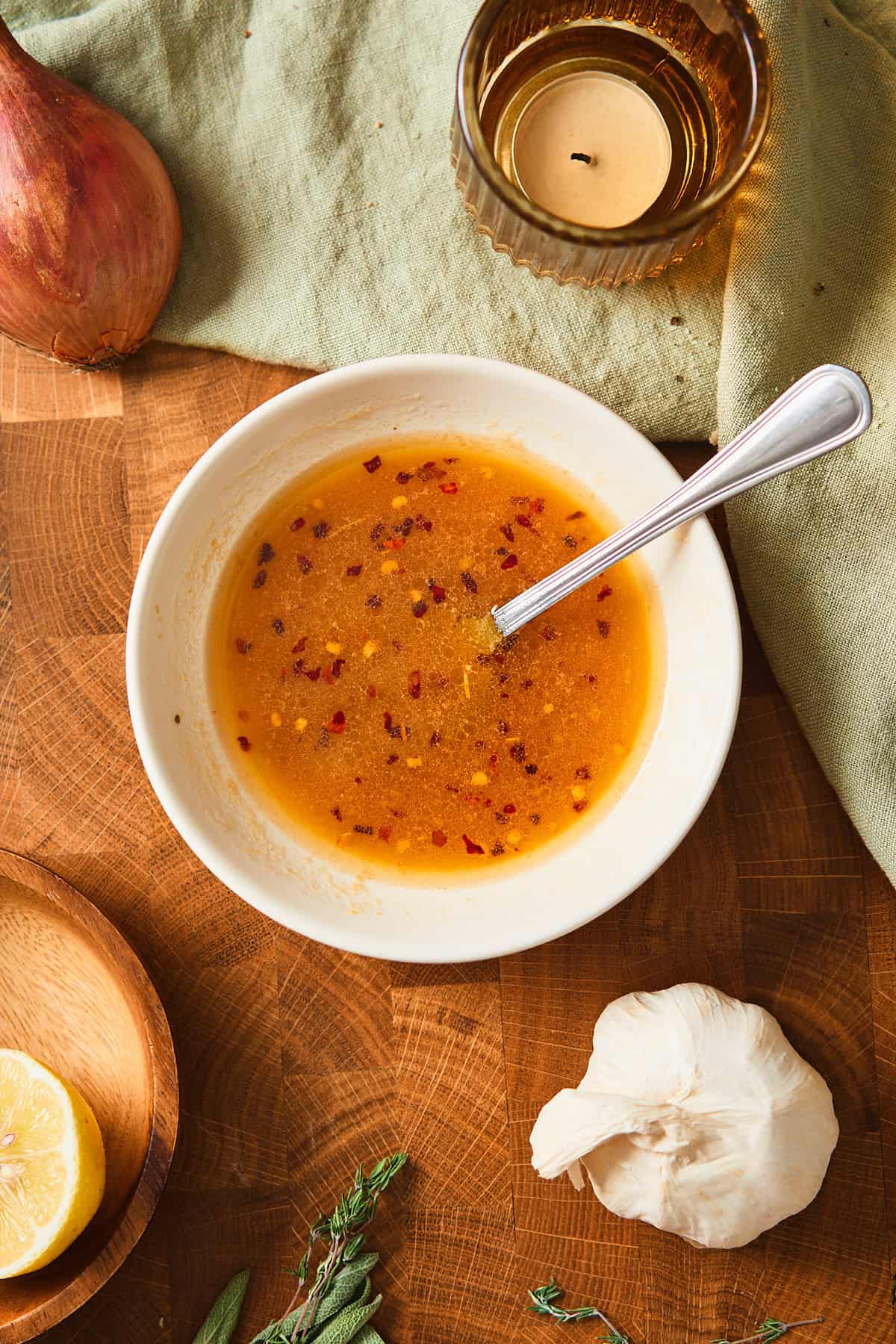
- Step 10: Roast at 425°F. About 20 minutes in, get the gravy going (see Make the Gravy While It Roasts, below), so it has plenty of time to simmer. Start checking the chicken at 40 to 45 minutes. Take two readings in the thickest part of the breast, away from the bone and cavity. While it roasts, whisk the maple syrup, Dijon, apple cider vinegar, red pepper flakes, and a pinch of salt, then slowly whisk in the warm melted butter. If the glaze thickens or separates, rewarm it for a few seconds and whisk again.
🔥 Every oven is a little different. We tried our first test in a countertop oven, where the bird sat too close to the top heating element and browned too fast. Keep an eye on yours, and if the skin starts browning too quickly, tent it loosely with foil. Our birds were ready for their glaze at about 45 to 50 minutes, so plan on about an hour in total, a little longer for a bigger bird. Your thermometer is the best guide. A leave-in probe lets you watch the breast and thigh without opening the oven. To be extra sure, you can use an instant-read as a backup. Ours read a little high after we moved the bird to glaze it, since a probe can shift when the bird does.
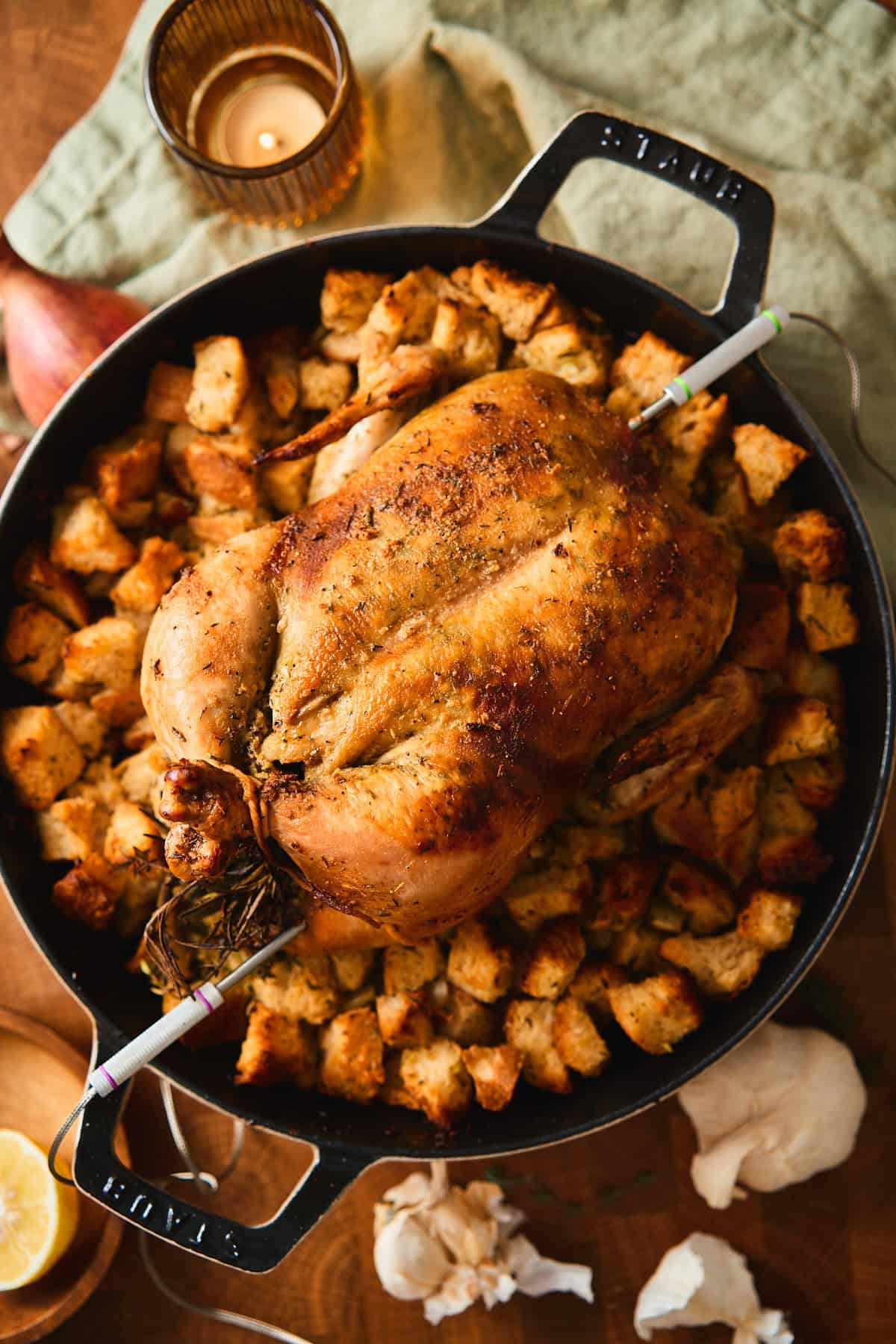
- Step 11: When the breast reads about 140°F, it's ready for its glaze.
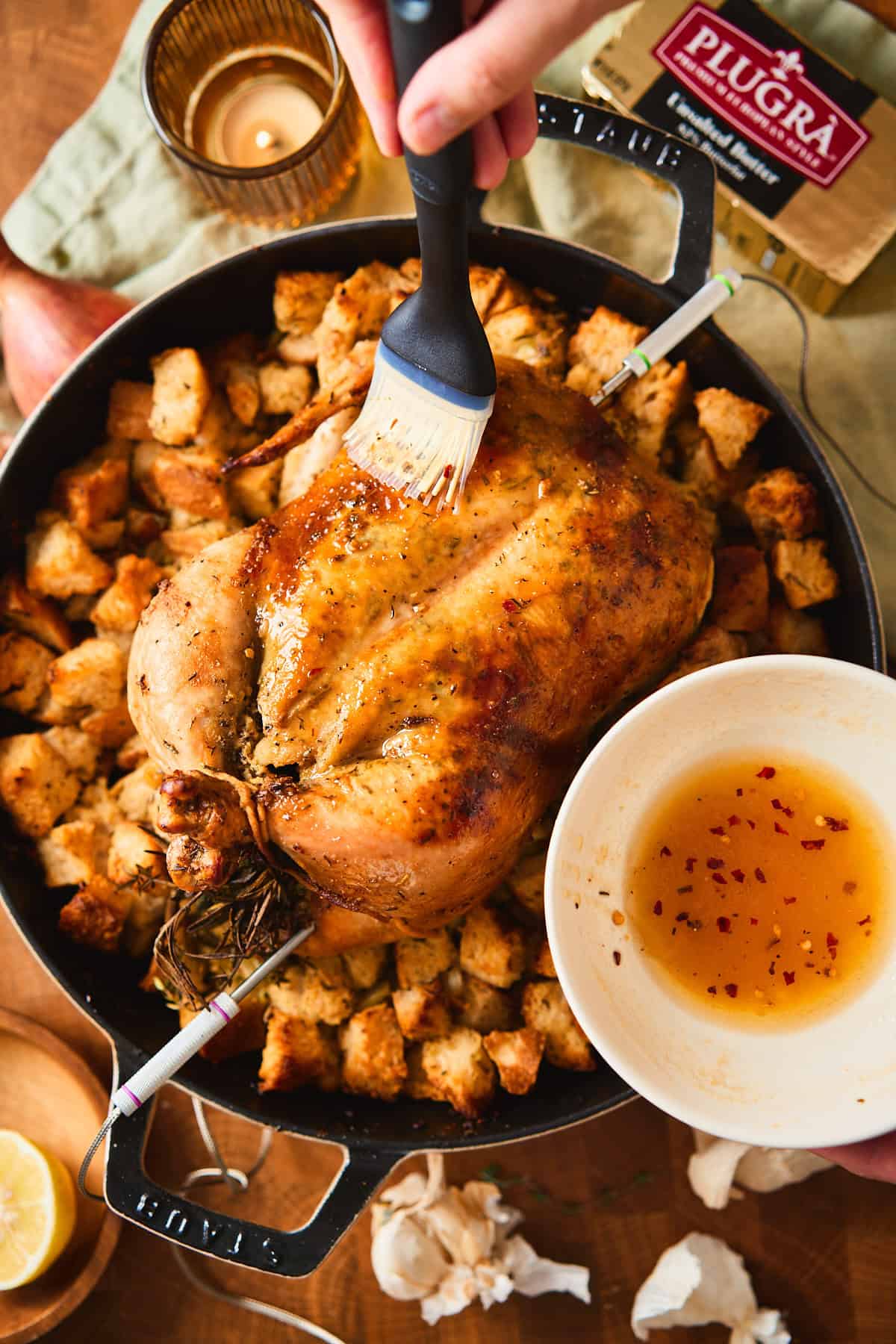
Brush on a thin coat of warm glaze, then keep roasting until the breast reads 160°F and the thighs read 175°F, about 15 to 20 minutes more. If anything darkens too fast, tent it loosely with foil.
🍁 Why the glaze waits. Maple scorches if it goes on too early, so it only needs those last few minutes. We also tried working maple into the butter, and Chamere and I agreed it tasted confused, like it couldn't decide between sweet and savory. 😂 Keeping the sweetness in the glaze solved it.
🌡️ Don't wait for 165°F in the oven. The breast keeps climbing as it rests, and pulling it early is what keeps it juicy. We pulled ours at 161°F, it climbed past 165°F while it rested, and it was still so juicy!
Make the Gravy While It Roasts
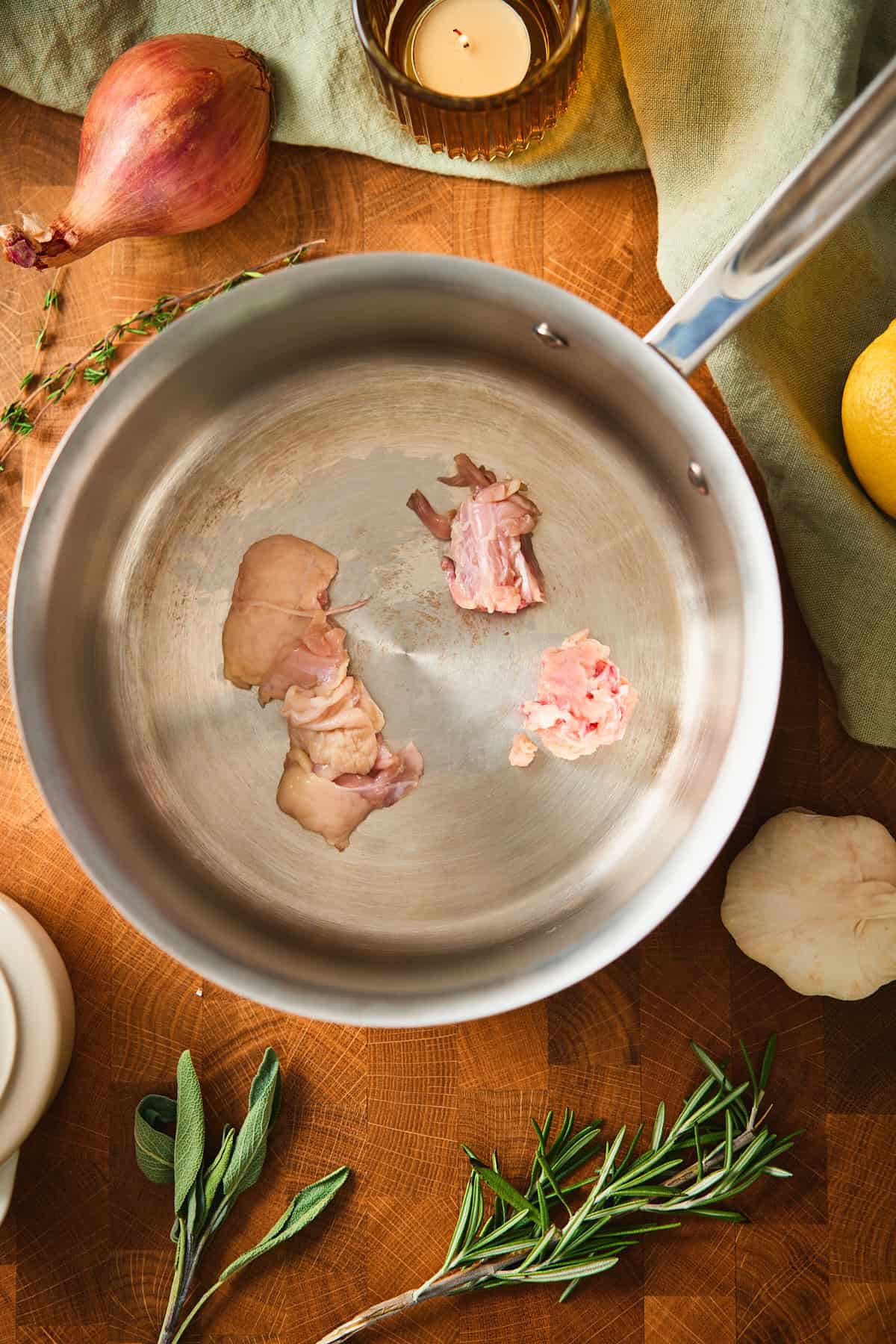
- Step 12: About 20 minutes into the roast, add the trimmed fat and skin (and the neck, if you have one) to a cold saucepan and set it over medium heat.
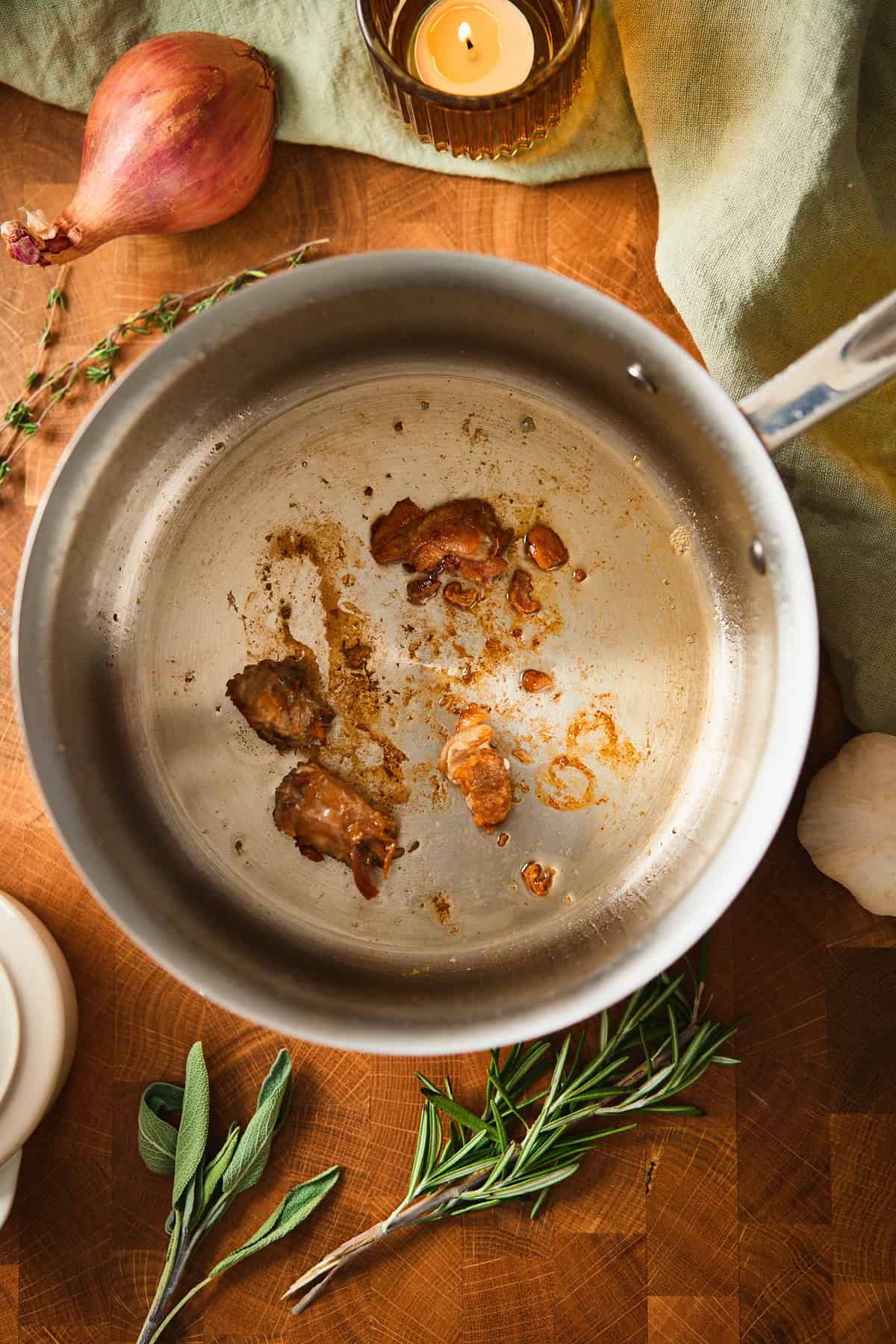
Let the fat render out until everything is deeply browned. Add the butter and let it foam and turn golden, then lift out the neck and crispy bits, setting the neck aside.
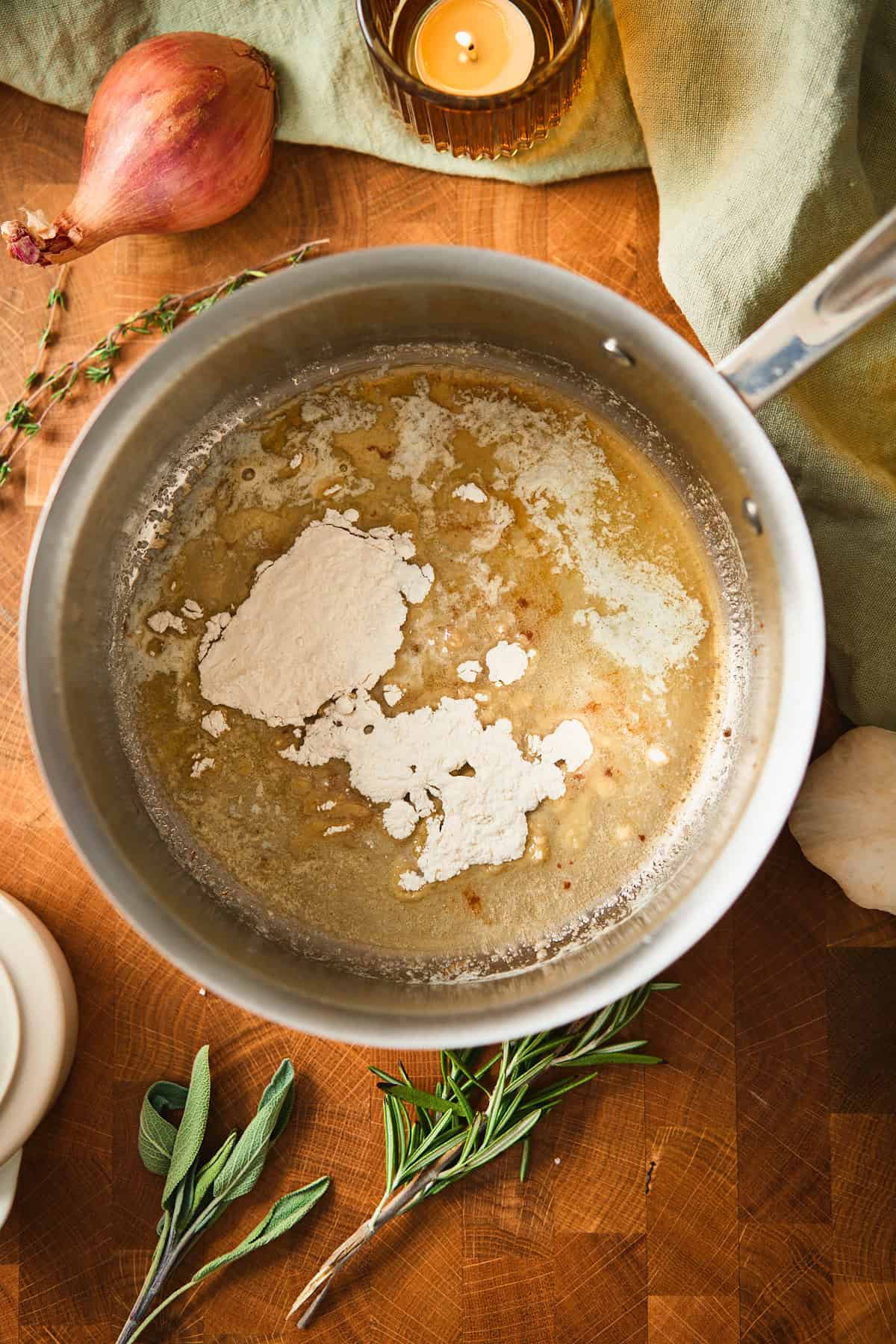
- Step 13: Whisk the flour into the butter and fat.
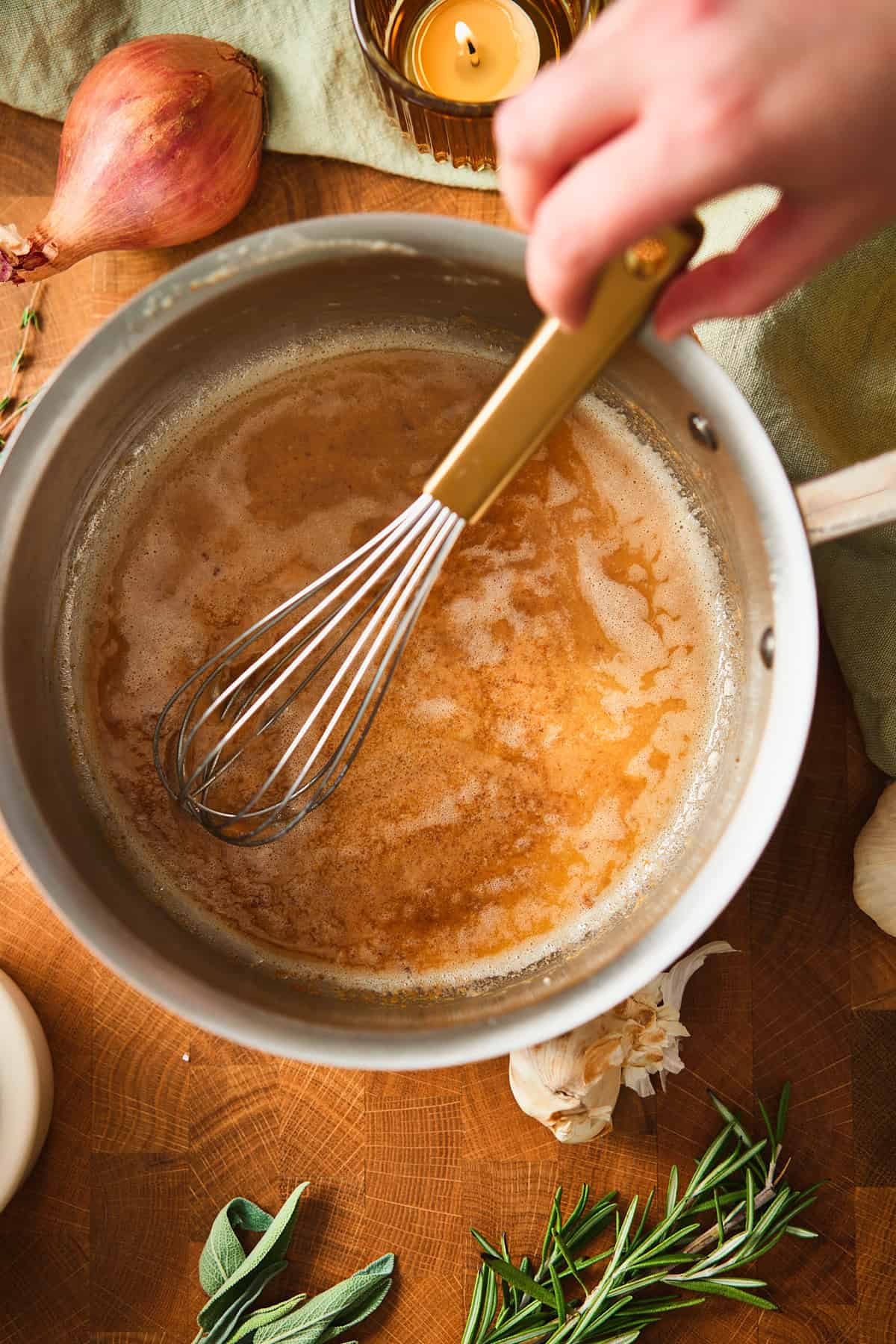
Keep whisking for a few minutes, until it smells nutty and turns the color of peanut butter. That toasty roux adds SO much flavor. It isn't gumbo, so there's no need to take it any darker!
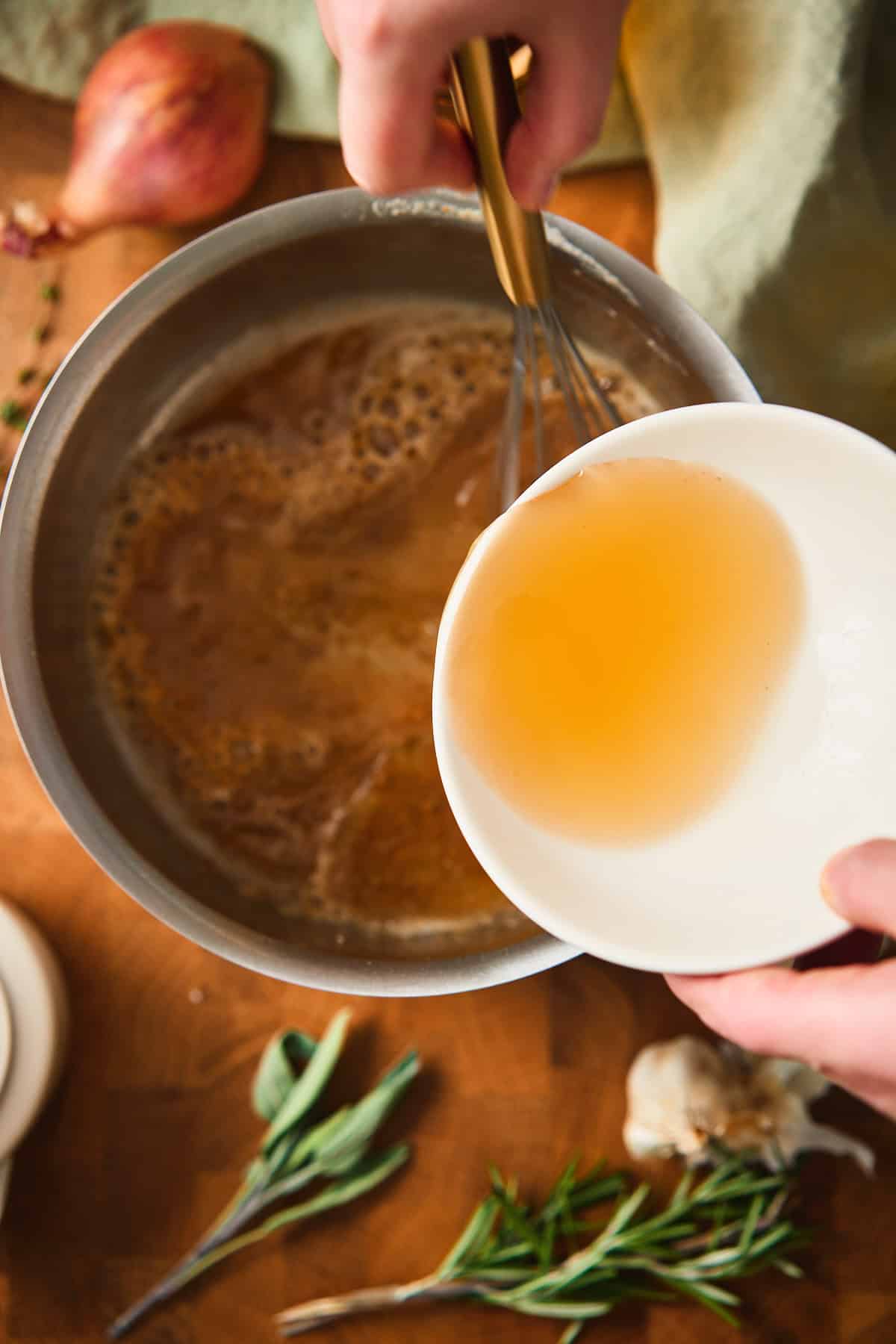
- Step 14: Slowly whisk in the broth. We use low-sodium broth here, since the salt concentrates as it reduces.
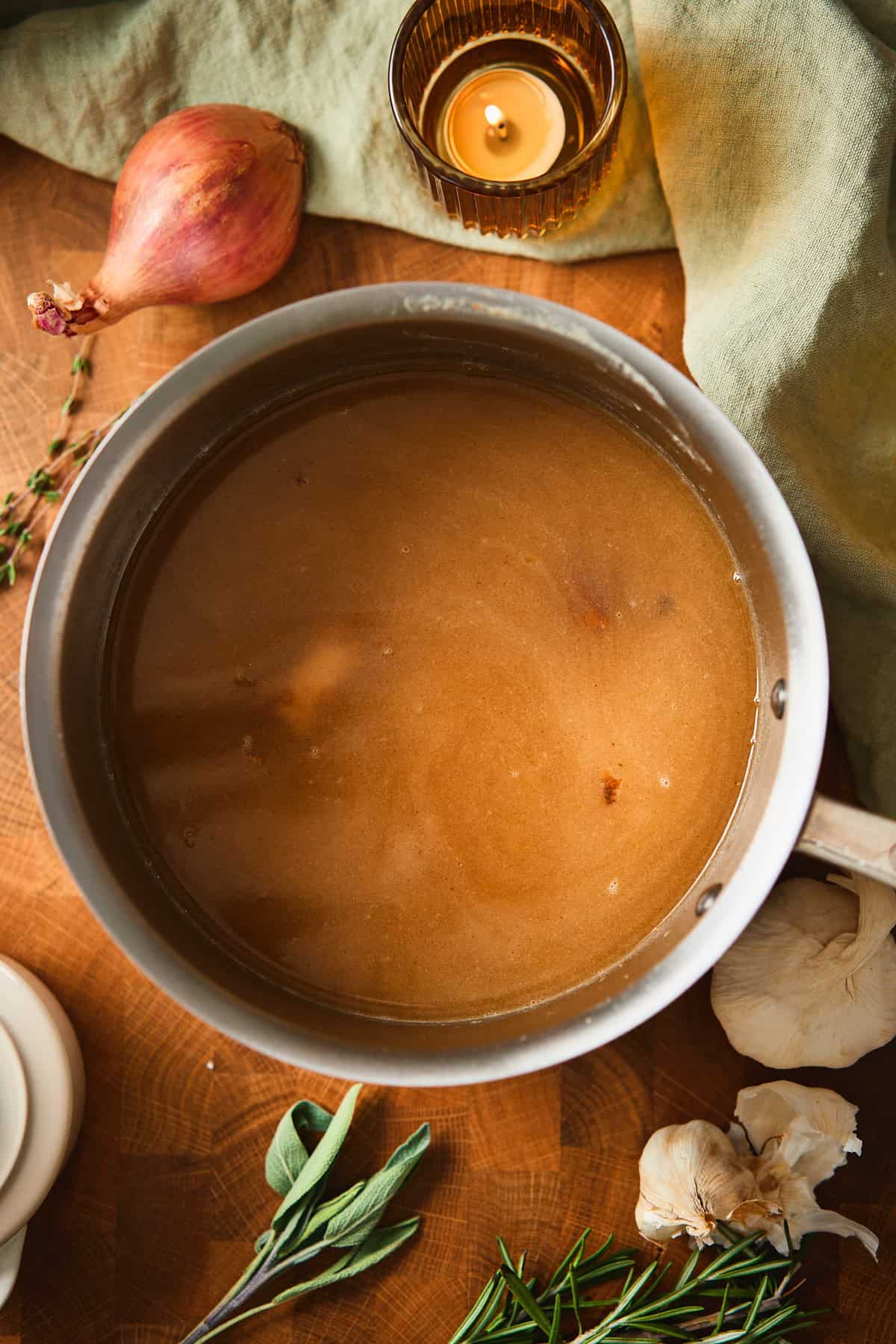
Drop the neck back in and let it simmer gently for about 30 minutes while the chicken roasts, stirring now and then, then keep it warm on low.
🧈 Why the gravy gets its own pan. The stuffing drinks up nearly every drop of drippings in the roasting pan, so this gravy builds its own flavor. We start by browning chicken fat and neck, a toasty roux, and a slow simmer, finished with those saved juices. Our first version tasted pretty flat, and this is the one Chamere called the best gravy ever. 😍
Rest, Crisp, and Finish the Gravy
- Step 15: Lift the bird out of the pan and tilt it over a small bowl or measuring cup, so all of that liquid gold in the cavity pours out. Don't let it go to waste, because it's going straight into the gravy! Rest the chicken on a cutting board with a juice groove for 15 to 20 minutes, and brush on more glaze. Save those resting juices for the gravy, too.
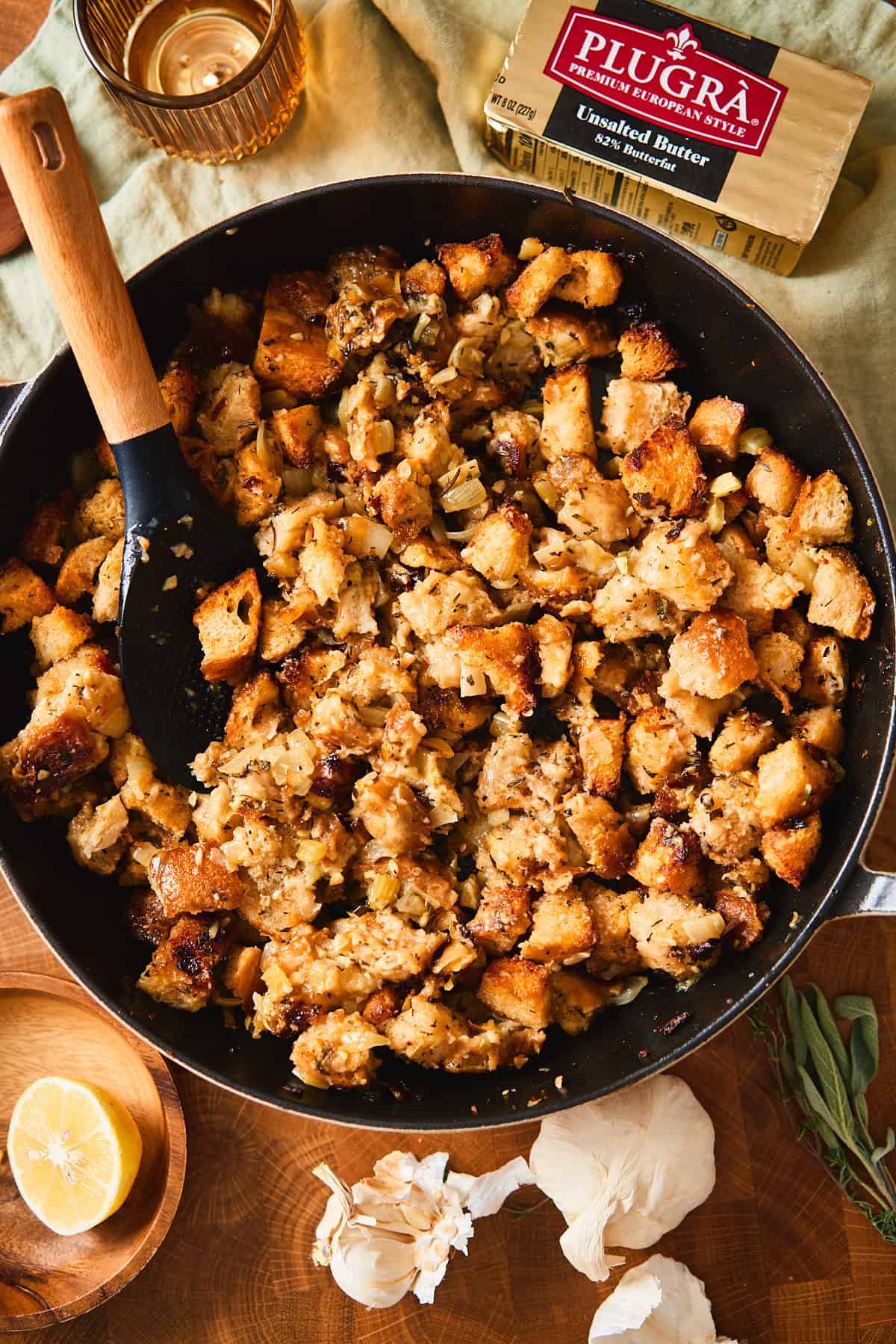
- Step 16: Toss the stuffing so the soaked center and the crispy edges mix together.
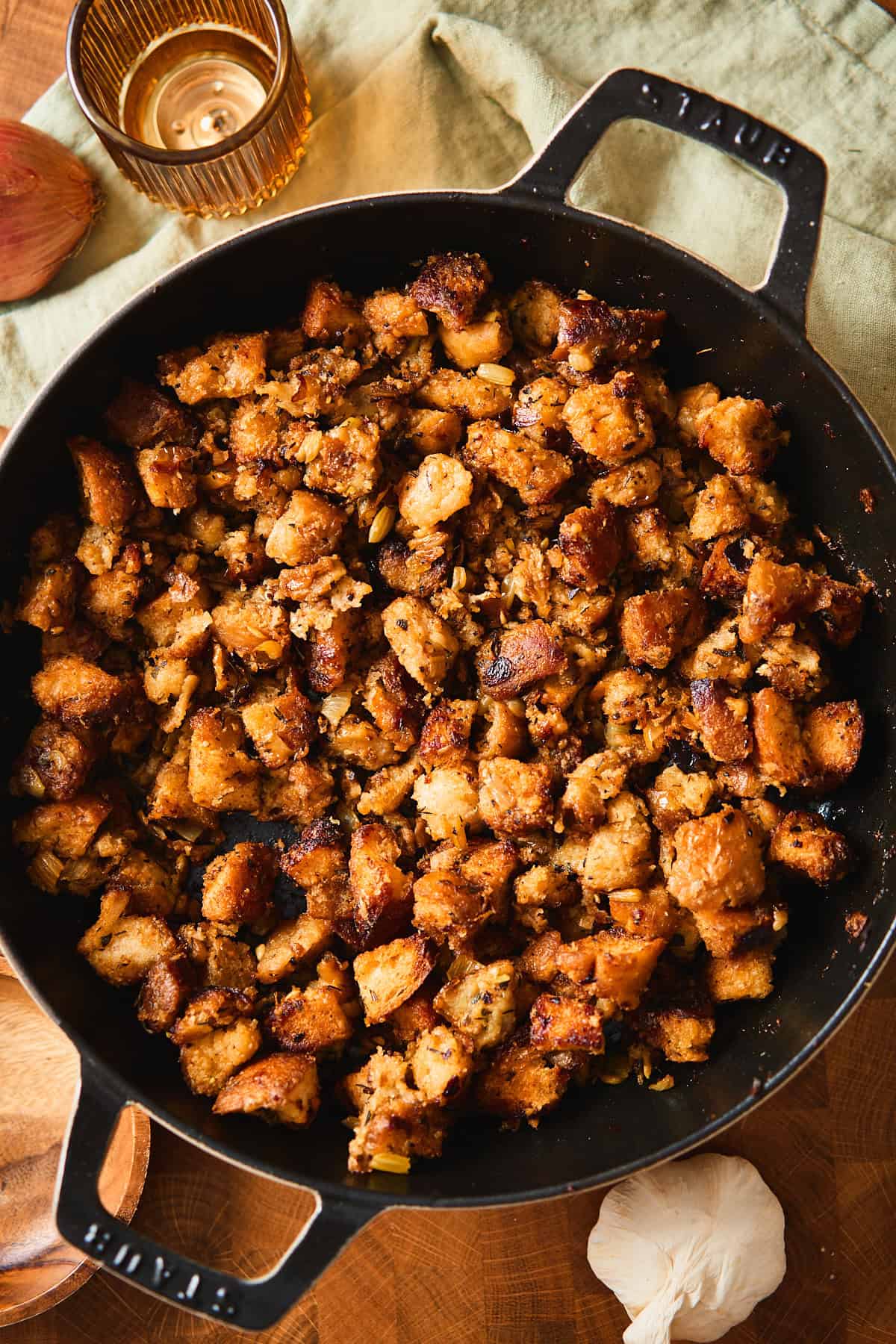
Return it to the oven, uncovered, for about 10 minutes while the chicken rests. The center should reach 165°F.
🤤 Don't skip the toss. The edges crisp up nicely on their own, but the bread under the bird can get a little wet. Tossing it lets everything reabsorb those juices, and the extra time in the oven brings it up to temperature and crisps it back up. Like it softer or crispier? Adjust the time to your taste, as long as the center hits 165°F.
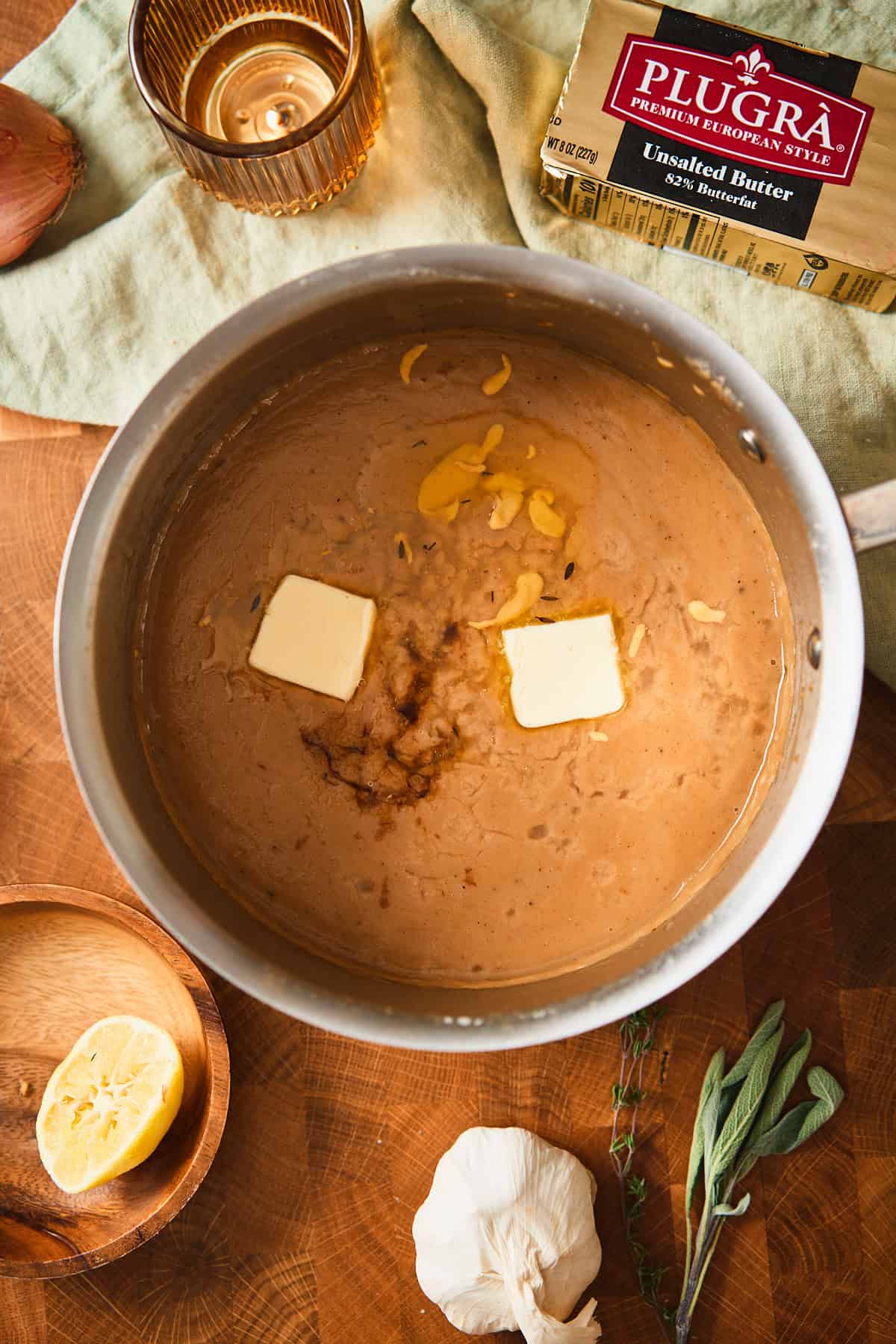
- Step 17: By now, the gravy should be thick enough to coat the back of a spoon, and a finger swiped across it should leave a clean line. A touch thick is just right here, because the juices will loosen it. Pull out the neck. While the chicken rests, stir the Dijon, Worcestershire, and saved cavity and resting juices into the gravy. Pull the pan off the heat and add the cold butter and a squeeze of juice from the other lemon half.
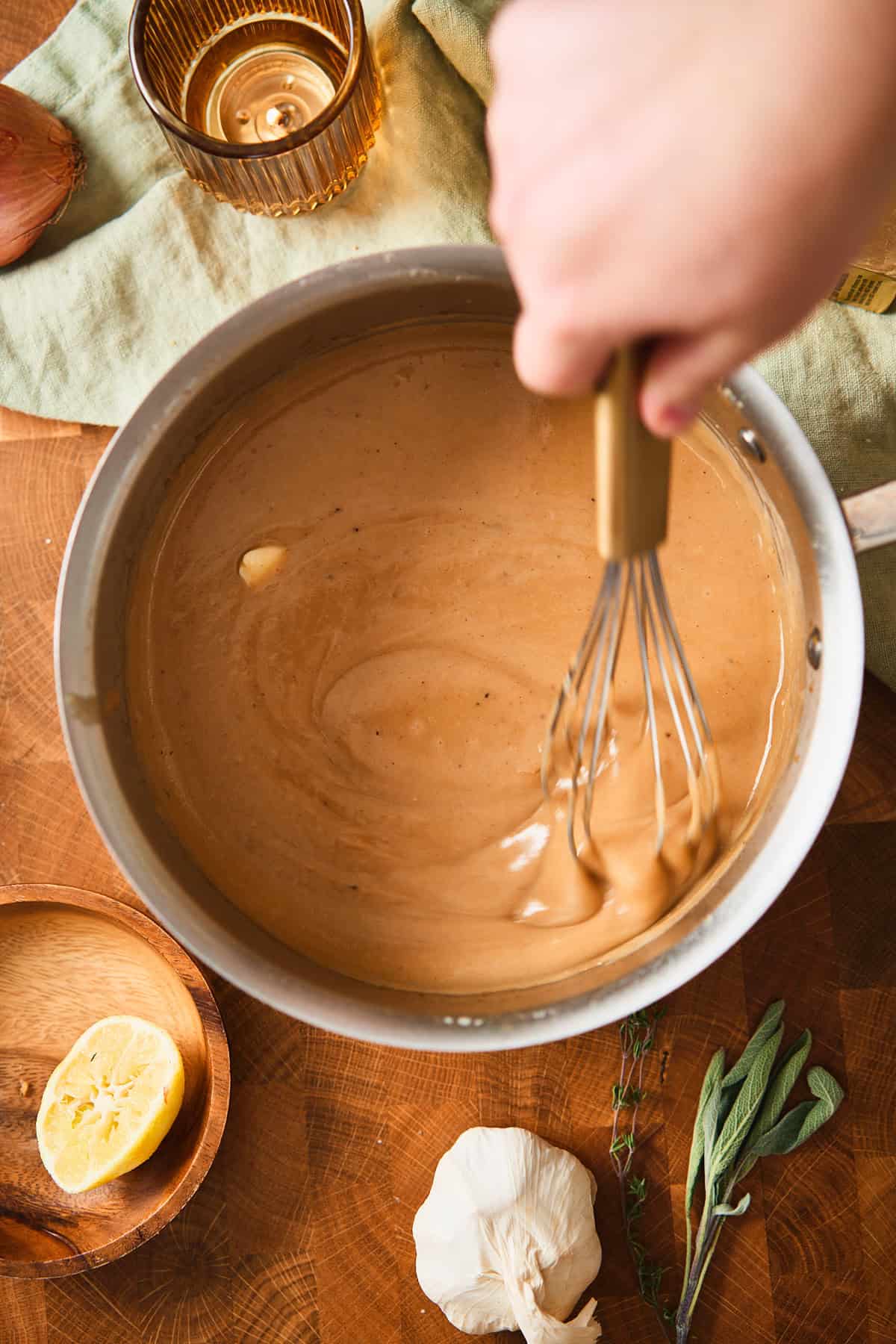
Whisk until the butter melts in. The cold butter is what makes it silky and glossy. Taste it and add salt if it needs it.
Carve and Serve
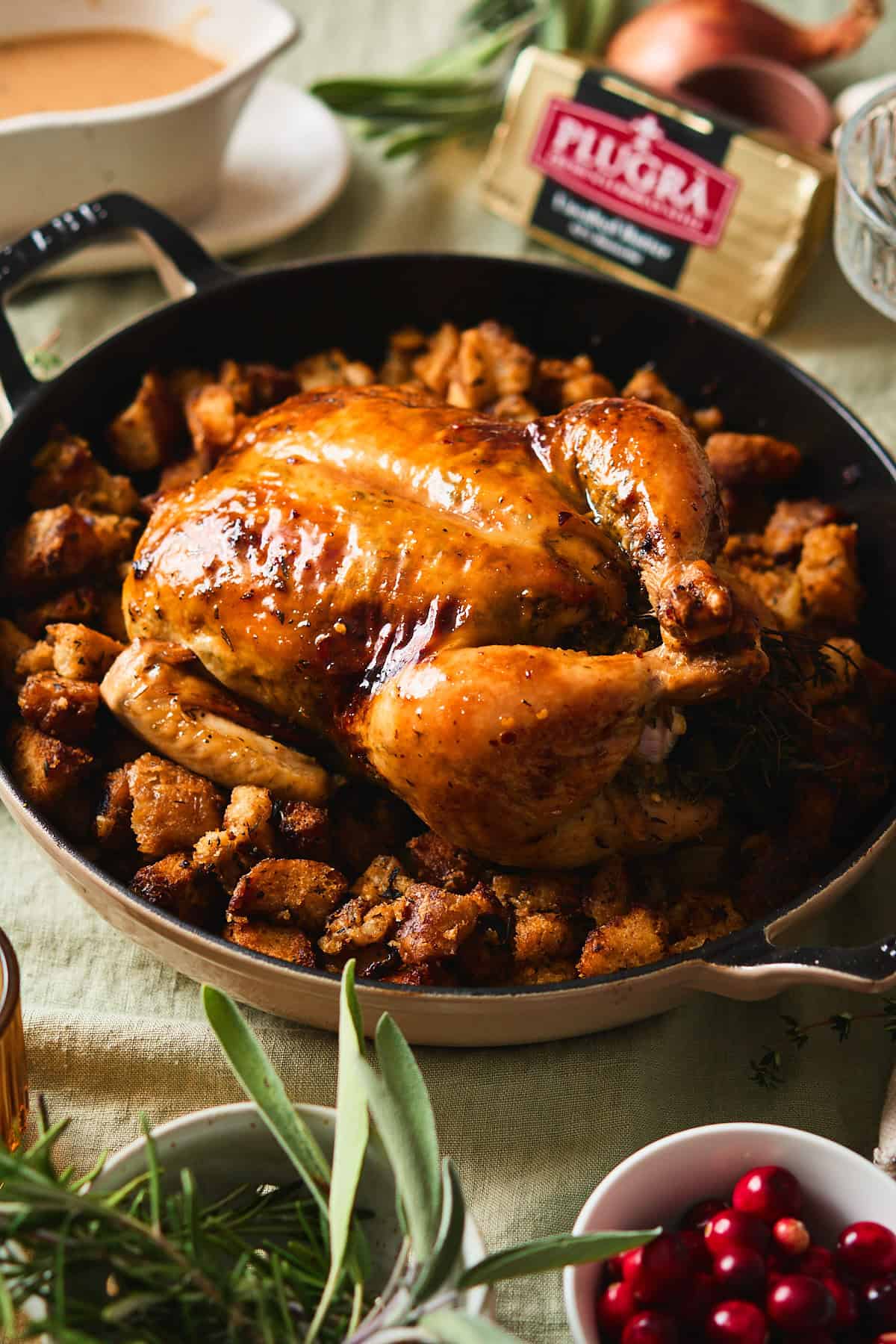
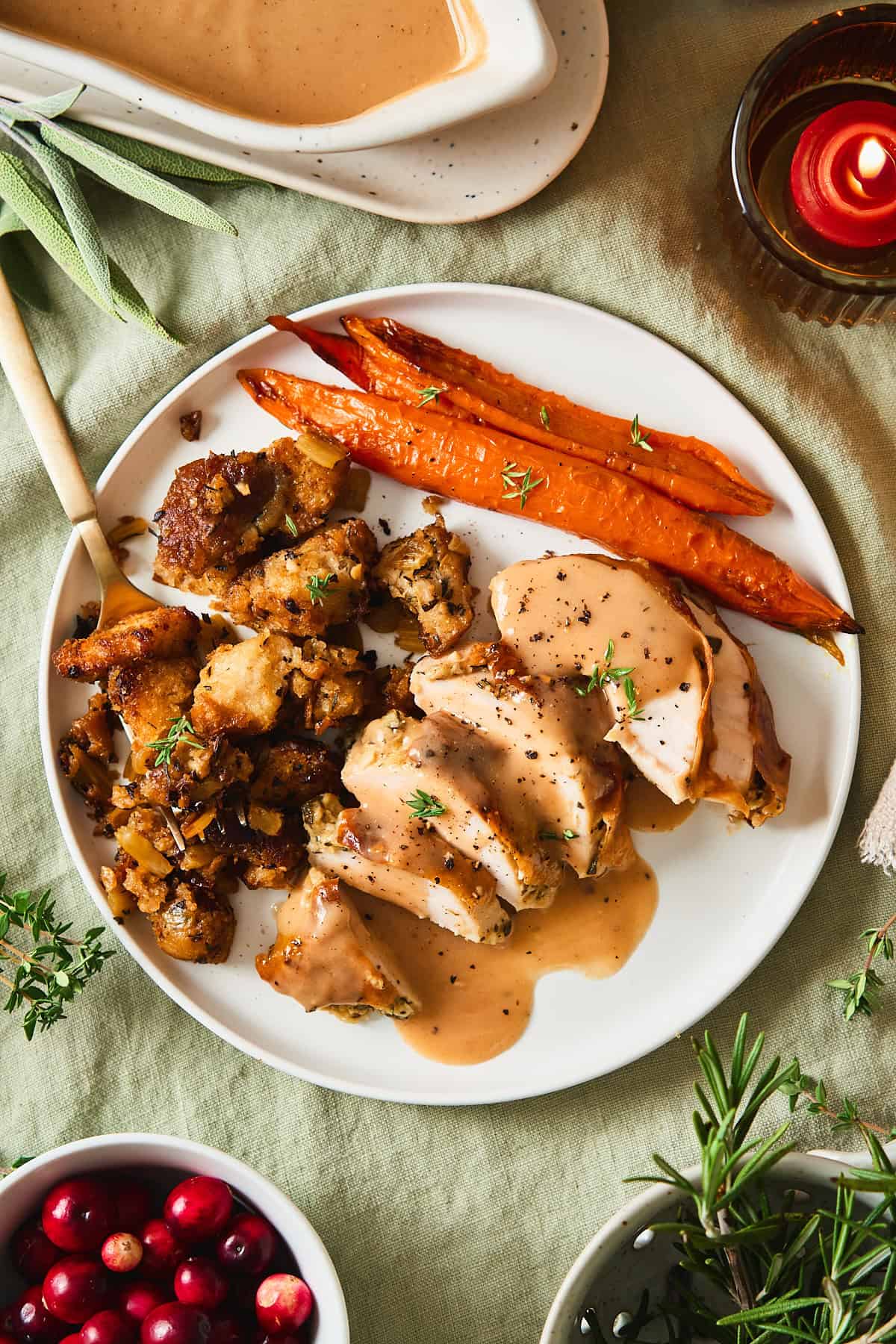
- Step 18: Set the bird back on the stuffing, then carve it right at the table. Spoon up plenty of stuffing, and pour that gravy over everything.
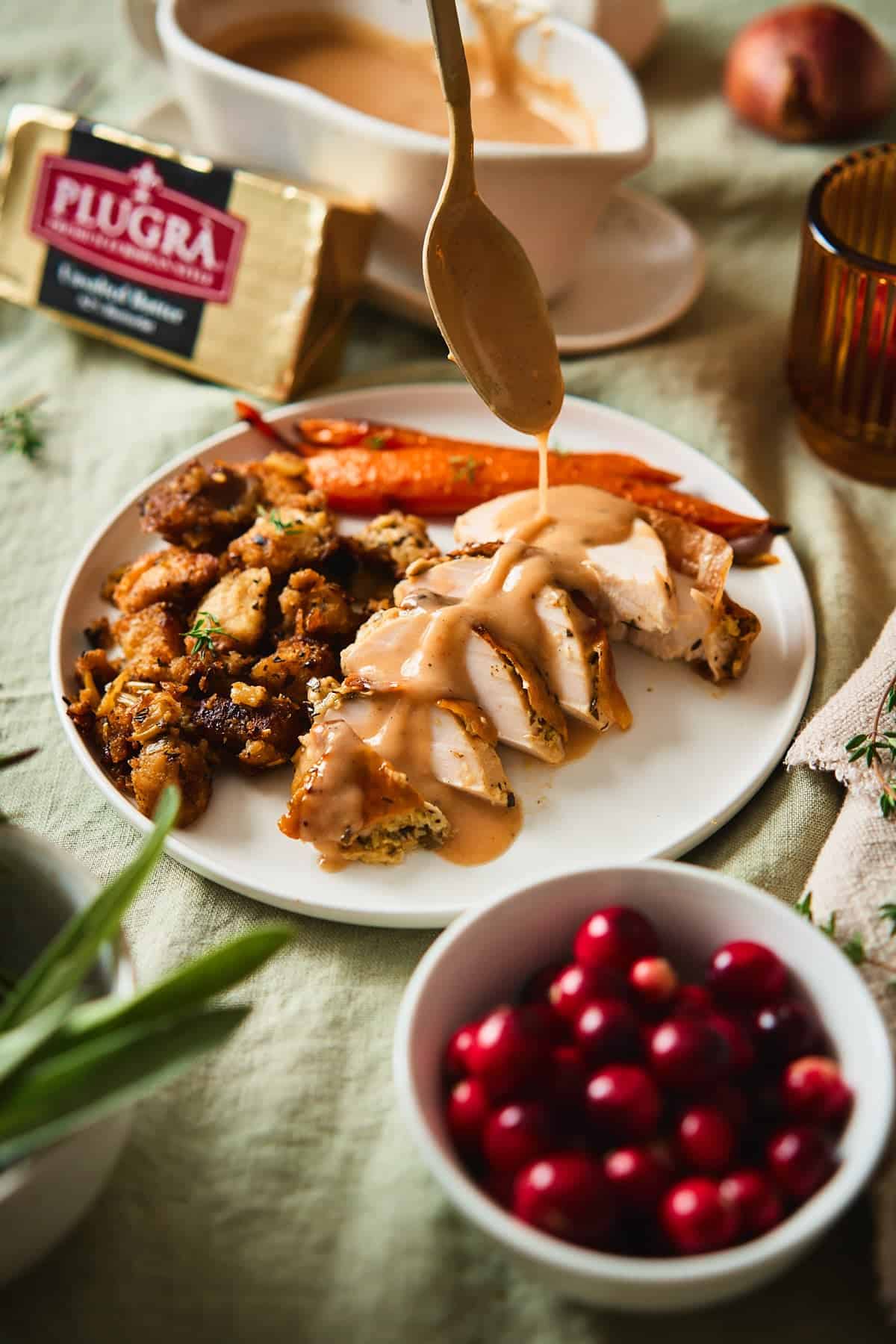
What to Serve with Thanksgiving Chicken 🍽️
The stuffing and gravy are already on the table, so you only need a side or two. Mac and cheese is pretty much non-negotiable for us, so a pan of our Cajun mac and cheese is usually on the table. Beyond that, we love buttermilk mashed potatoes or fondant potatoes and a pan of roasted green beans and carrots.
🌟Leave a Review!
If you make this One-Pan Roast Chicken and Stuffing, we'd love to hear from you! Leave a comment below with your rating for the recipe. Share with us by tagging us on Instagram! We love seeing your creations! 📸
📖 Recipe
Thanksgiving Chicken and Stuffing in One Pan
Equipment
- deep 12-inch oven-safe skillet or braiser
- small saucepan
- instant-read or leave-in probe thermometer
- microplane or zester for the lemon
Ingredients
Dry Brine
- 1 whole chicken 3½ to 4½ pounds, neck and extra fat saved for the gravy
- 2 tablespoons kosher salt 18 grams for a 4-pound bird, or 1% of the bird's weight; use 1¼ tablespoons if using Morton's or 1 tablespoon table salt, see notes
- ½ teaspoon dried thyme
- ¼ teaspoon dried sage
- ½ teaspoon garlic powder
- ½ teaspoon onion powder
- ½ teaspoon black pepper
Herb Butter and Roasting
- 6 tablespoons unsalted butter Plugrà butter, 85 grams, softened
- 2 tablespoons Dijon mustard
- 5 cloves garlic about 25 grams, finely minced
- ½ small shallot about 20 grams, finely minced
- 1 tablespoon fresh thyme leaves finely chopped
- 1 tablespoon fresh sage finely chopped
- 1 teaspoon fresh rosemary finely chopped
- 1 lemon zested, then halved
- 1 teaspoon kosher salt use ½ teaspoon if using Morton's or table salt, see notes
- 1 teaspoon coarsely cracked black pepper
- 1½ tablespoons unsalted butter Plugrà butter, 21 grams, melted, for brushing
- 1 shallot halved, for the cavity
- 1 small bundle fresh herbs such as thyme, sage, and rosemary, for the cavity
Stuffing
- 8 to 9 cups sourdough bread cubes about 425 grams, cut into 1-inch cubes
- 5 tablespoons unsalted butter Plugrà butter, 71 grams
- 1 large yellow onion about 200 grams, diced
- 4 ribs celery about 190 grams, diced
- 1 teaspoon kosher salt or to taste, use ½ teaspoon if using Morton's or table salt, see notes
- 12 cloves garlic about 55 grams, minced
- 1 tablespoon fresh thyme leaves chopped
- 1 tablespoon fresh sage chopped
- ½ teaspoon fresh rosemary chopped
- ⅔ cup chicken broth well seasoned
- black pepper to taste
Maple Dijon Glaze
- 1½ tablespoons unsalted butter Plugrà butter, 21 grams, melted
- ¼ cup pure maple syrup
- 2¼ teaspoons Dijon mustard
- 1 teaspoon apple cider vinegar
- scant ¼ teaspoon red pepper flakes
- kosher salt to taste
Gravy
- reserved chicken fat, skin, and neck trimmed from the bird
- 4 tablespoons unsalted butter Plugrà butter, 57 grams
- 4 tablespoons all-purpose flour 32 grams
- 3 cups low-sodium chicken broth
- reserved cavity and resting juices
- 1 teaspoon Dijon mustard
- ½ teaspoon Worcestershire sauce
- 1 teaspoon lemon juice from the reserved lemon half
- 2 tablespoons cold unsalted butter Plugrà butter, 28 grams
- kosher salt to taste
Instructions
The Night Before
- Trim the chicken. Remove the neck if your bird came with one, and trim the extra fat and skin from around the cavity opening. Refrigerate them for the gravy.1 whole chicken
- Dry brine. Pat the chicken dry. Mix the salt, dried thyme, dried sage, garlic powder, onion powder, and black pepper, then rub it all over the bird and inside the cavity. Refrigerate uncovered overnight.2 tablespoons kosher salt, ½ teaspoon dried thyme, ¼ teaspoon dried sage, ½ teaspoon garlic powder, ½ teaspoon onion powder, ½ teaspoon black pepper
- Dry the bread. Cut the sourdough into 1-inch cubes, spread them on a sheet pan, and leave them on the counter overnight to dry.8 to 9 cups sourdough bread cubes
Herb Butter and Stuffing
- Heat the oven. Heat the oven to 425°F with a rack in the lower-middle position. If the bread isn't dry, heat the oven to 275°F first and bake the cubes for 20 to 30 minutes, tossing halfway, until crisp but not browned, then raise the heat to 425°F.
- Make the herb butter. Mash the softened butter with the Dijon, minced garlic, minced shallot, thyme, sage, rosemary, lemon zest, salt, and pepper. Halve the zested lemon.6 tablespoons unsalted butter, 2 tablespoons Dijon mustard, 5 cloves garlic, ½ small shallot, 1 tablespoon fresh thyme leaves, 1 tablespoon fresh sage, 1 teaspoon fresh rosemary, 1 lemon, 1 teaspoon kosher salt, 1 teaspoon coarsely cracked black pepper
- Build the stuffing. Melt the butter in a deep 12-inch oven-safe skillet or braiser over medium heat. Add the onion, celery, and salt and cook until soft, then add the garlic, thyme, sage, and rosemary and cook for 1 minute. Turn off the heat and pour in the broth, then toss in the bread and season with pepper, adding more salt to taste. Go light at first, since the drippings will season the stuffing more in the oven. Spread it into an even layer for the bird to sit on, then pile any extra around the edges.5 tablespoons unsalted butter, 1 large yellow onion, 4 ribs celery, 1 teaspoon kosher salt, 12 cloves garlic, 1 tablespoon fresh thyme leaves, 1 tablespoon fresh sage, ½ teaspoon fresh rosemary, ⅔ cup chicken broth, black pepper
Butter and Roast the Chicken
- Butter the chicken. Pat the bird dry and tuck the wings. Gently loosen the skin over the breast and thighs, work all of the herb butter underneath, and press it flat from the outside.
- Truss. Tuck one lemon half, the halved shallot, and the herb bundle into the cavity, saving the other lemon half for the gravy. Truss the legs with kitchen twine, brush the melted butter over the skin, and set the chicken breast side up in the center of the stuffing.1 shallot, 1 small bundle fresh herbs, 1½ tablespoons unsalted butter
- Roast. Roast at 425°F. Start the gravy about 20 minutes in. Start checking the chicken at 40 to 45 minutes, taking two readings in the thickest part of the breast, away from the bone and cavity.
Start the Gravy
- Brown the fat. Put the reserved fat, skin, and neck in a cold saucepan over medium heat and cook 6 to 8 minutes, until the fat renders and everything is deeply browned. Add the butter and let it foam and turn golden, 1 to 2 minutes. Lift out the neck and crispy bits, setting the neck aside.reserved chicken fat, skin, and neck, 4 tablespoons unsalted butter
- Toast the roux. Whisk in the flour and cook 3 to 5 minutes, whisking, until it smells nutty and turns the color of peanut butter.4 tablespoons all-purpose flour
- Simmer. Slowly whisk in the broth, return the neck to the pan, and simmer gently for about 30 minutes, stirring now and then, until it reduces to about 2½ cups and coats the back of a spoon. Remove the neck and keep the gravy warm on low.3 cups low-sodium chicken broth
Glaze, Rest, and Finish
- Make the glaze. Whisk the maple syrup, Dijon, vinegar, red pepper flakes, and salt, then slowly whisk in the warm melted butter. If it thickens or separates, rewarm it for a few seconds and whisk again.1½ tablespoons unsalted butter, ¼ cup pure maple syrup, 2¼ teaspoons Dijon mustard, 1 teaspoon apple cider vinegar, scant ¼ teaspoon red pepper flakes, kosher salt
- Glaze. When the breast reads about 140°F (about 45 to 50 minutes), brush on a thin coat of glaze. Roast until the breast reads 160°F and the thighs read 175°F, about 15 to 20 minutes more. If the skin darkens too fast, tent it loosely with foil.
- Rest the chicken. Lift the chicken out of the pan and tilt it over a small bowl to catch the cavity juices for the gravy. Rest it on a cutting board for 15 to 20 minutes and brush with more glaze. Save the resting juices.
- Crisp the stuffing. Toss the stuffing so the soaked center and crispy edges mix together, then return it to the oven, uncovered, for about 10 minutes, until the center reaches 165°F.
- Finish the gravy. It should be a touch thick at this point. Stir in the Dijon, Worcestershire, and saved cavity and resting juices, which will loosen it. Off the heat, whisk in the cold butter and lemon juice. Taste and add salt as needed.reserved cavity and resting juices, 1 teaspoon Dijon mustard, ½ teaspoon Worcestershire sauce, 1 teaspoon lemon juice, 2 tablespoons cold unsalted butter, kosher salt
- Serve. Set the chicken back on the stuffing, carve it at the table, and serve with the gravy.
Save This Recipe! 💌
Notes
- A note on salt. This recipe was developed with Diamond Crystal kosher salt at 1% of the bird's weight. For a 4-pound bird, that's 18 grams: about 2 tablespoons of Diamond Crystal, 1¼ tablespoons of Morton's kosher salt, or 1 tablespoon of table salt. Morton's and table salt are denser, so for the rest of the recipe, use about half the listed amount and add more to taste.
- Using salted butter. Unsalted butter gives you the most control, since the bird is already seasoned from the brine. Salted butter works too, just cut back on the added salt: use ½ teaspoon of Diamond Crystal instead of 1 teaspoon in both the herb butter and the stuffing, and taste the gravy before salting it. Salted butter varies by brand, so taste as you go.
- Pan options. We use a 12-inch Staub braiser with no lid. Any deep 12-inch oven-safe skillet works, as long as the bird fits with a ring of stuffing around it. Or cook the vegetables in any skillet and move everything to a baking dish before adding the bird.
- Go by temperature. Every oven is different, so start checking early. Pull the chicken at 160°F in the breast and 175°F in the thigh, and it will climb to 165°F as it rests. The stuffing should reach 165°F in the center. If you're using a leave-in probe, you can check with an instant-read as a backup to be extra sure.
- No neck? Many birds come without one. The browned fat and skin still give the gravy plenty of flavor.
- Leftovers. Store the chicken, stuffing, and gravy in separate airtight containers in the fridge for 3 to 4 days. Extra chicken is perfect in our creamy chicken pot pie soup.
- What to serve with it. Add a side or two, like buttermilk mashed potatoes or roasted green beans and carrots.


Comments
No Comments